President Donald Trump said the East Wing of the White House was demolished to erect a massive new ballroom, but it turns out that was only the sales pitch. The fine print tells a much different story, some observers fear.
In plain terms, Trump isn’t just planning a place to host events. He’s building a secret separate residence, paid for by taxpayers. The project has less to do with chandeliers and more to do with preparing for unrest, conflict, and the growing concern that Trump may not be planning an exit anytime soon.
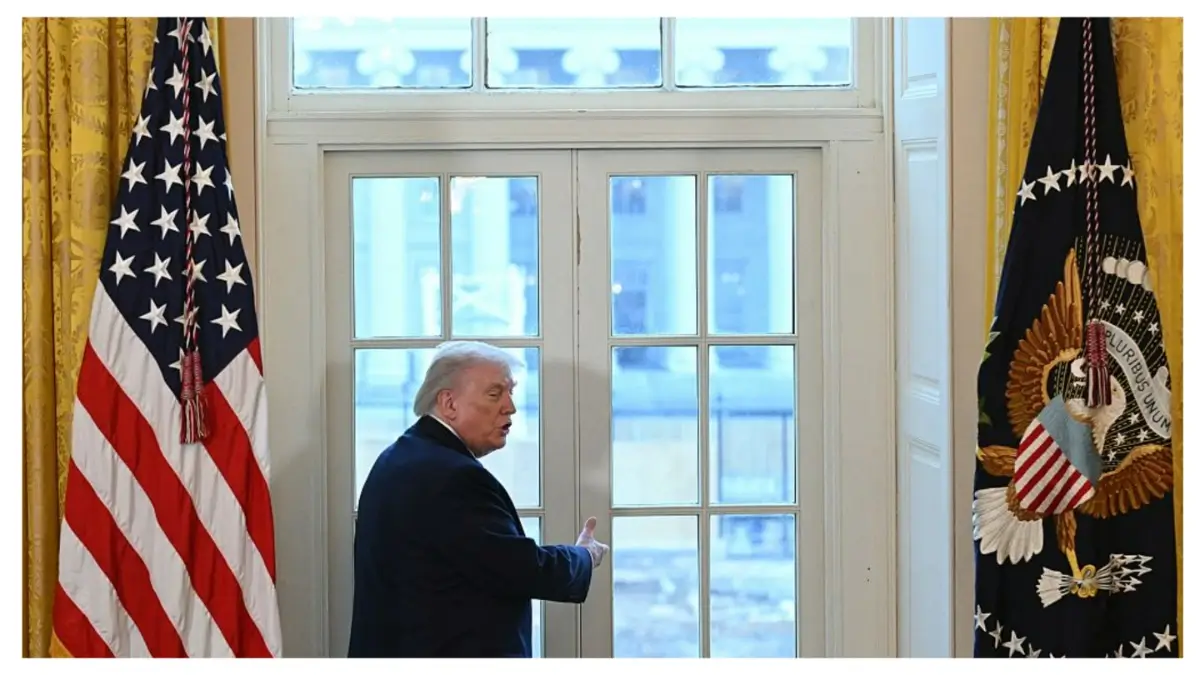
A new CNN report describes how beneath the rubble Trump is rebuilding the Presidential Emergency Operations Center — not just as a crisis bunker, but as a fully livable refuge for himself.
The bunker beneath the East Wing is being rebuilt from the ground up, complete with a new command center and full living quarters. The network reported its sources said the original underground structure was removed entirely when demolition began last October, during the government shutdown.
While the White House talks about what the public will see above ground, the most significant work is happening several stories below — a reminder, critics argue, that there’s always a catch with Trump, usually in the form of an unadvertised second act. The plans and cost remain classified.
CNN contributor Jonathan Wackrow, a former U.S. Secret Service agent, said the public will likely never know the full scope of what is being constructed deep below the White House. “If you think about trying to mitigate the threats today and the threats for tomorrow, you’re really talking about emerging technologies, emerging infrastructure — stuff that may not be commercially available,” Wackrow said.
As details emerged, social media erupted over the political implications, with many expressing a deep fear about Trump’s lust to stay in power.
“Whoever wins in 2028 is going to have a hell of a time evicting him,” one wrote.
Others turned to gallows humor: “Just seal it up” and “Weld the door shut, cut the power, and walk away.”
Another added: “HE’S. NOT. LEAVING. And if he dies, they’re gonna entomb him in that bunker and continue to release AI videos of him for at least another 10 years. SOMEONE F—KING DO SOMETHING.”
View on Threads
One person wrote, “Permanently reside in a bunker at the White House? Nothing about that sentence is sane. Can we please have some adults f—king run this country? This entire Presidency is like a child’s game of pretend turned real.”
A handful of conservative voices clapped back.
“So you all managed to twist an existing bunker being upgraded as it has been in the past into Trump planning to permanently live there. Okayyyy. You people are delusional.”
Others compared the bunker to solitary confinement.
“He’s not long for this world. No one lives forever. A bunker can also be a jail cell or a coffin.”
Mockery followed close behind: “So Yam Hitler is starting WWIII and then he’s gonna ride it out in his new nuke-proof bunker full of Cheetos and Diet Coke? MAGA!”
One commenter added, “It probably has its own McDonald’s.”
The original underground fortress was built during World War II after the attack on Pearl Harbor. Over decades, it served as a hardened nerve center for emergencies.
On Sept. 11, 2001, then–Vice President Dick Cheney and senior officials were rushed there as the country came under attack. Richard Nixon used it for secret meetings and Joe Biden used the space to plan a clandestine trip to Ukraine.
Trump retreated to the bunker in 2020 during intense protests that followed the police killing of George Floyd.
One source told CNN there is a “high degree of confidence” that all previous subterranean facilities were removed during the demolition of the East Wing. Another said critical elements — including ventilation systems and critical security features are gone, suggesting the bunker is being rebuilt as something entirely new.
The PEOC has long been described as fully self-sufficient with independent power, water, and air filtration, capable of surviving a major attack or even a nuclear strike. Rebuilding such a facility today, experts note, means incorporating emerging technologies that are extraordinarily expensive.
Reactions reflected concerns that went well beyond the price tag.
“It’s incomprehensible to me that after hearing this information the anchor only asks questions about the taxpayer cost. Not the lunacy of him squirreling up in a bunker after the ridiculous and illegal demolition of the East Wing or the logical conclusion that he plans to stay there and never leave.”
Above ground, Trump initially pegged the cost of the new ballroom at $200 million. That figure has since ballooned to $400 million, and that doesn’t include the underground construction.
Another added: “Which means it’s not about a ballroom, it’s about him hiding out and not leaving the seat. He knows what’s coming.”
Those anxieties aren’t coming out of nowhere. In early 2026, U.S. forces carried out a high-profile intervention in Venezuela that removed Nicolás Maduro from power — a deeply controversial use of military force halfway around the world that critics say reflects a willingness to act unilaterally and dangerously in the Western Hemisphere.
At the same time, Trump has escalated tensions with European allies with repeated threats to seize or exert control over Greenland, prompting NATO members to reinforce defenses there and sparking diplomatic blowback across the Atlantic.
These moves fit within a broader Trump foreign-policy framework that embraces a modern take on the Monroe Doctrine — rejected by many allies as imperialistic — and suggests confrontation and territorial jockeying rather than cautious diplomacy, reinforcing for critics the very sense of instability that has fueled talk of bunkers and “what’s coming.”


