President Donald Trump has a habit of recognizing danger mid-sentence — and plowing ahead anyway. One minute he’s warning reporters that an answer could cause problems, the next he’s saying it out loud and setting off a chain reaction his own administration would soon struggle to contain.
That pattern resurfaced aboard Air Force One after a reporter asked Trump about the U.S. overnight operation in Venezuela on Saturday, Jan. 3, which resulted in the arrest of Venezuelan President Nicolás Maduro and his wife, Cilia Flores, on federal drug trafficking and weapons charges.
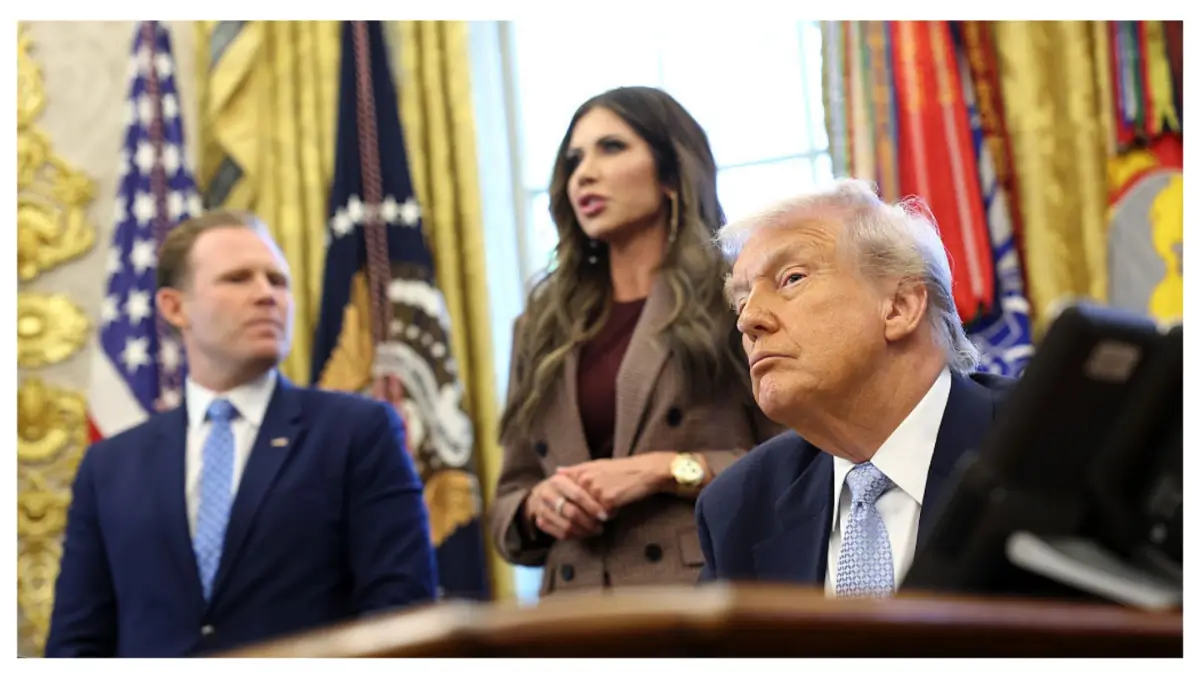
What began as an attempt to dodge the question quickly veered into something messier — and, within hours, Homeland Security Secretary Kristi Noem would add her own remarks that only deepened the fallout.
The pair appeared in a New York court Monday, Jan. 5, and pleaded not guilty to the charges, which were brought against them in an indictment in 2020 and a newer superseding indictment by the Justice Department, according to The Hill.
During his trip from Mar-a-Lago back to Washington on Sunday, a reporter asked Trump who’s in charge in Venezuela.
“Have you spoken to the newly sworn in president?” they asked.
Trump tried to claim he was dealing with the same Maduro government officials who are still in charge of the impoverished South American nation, but then he fell right into the reporter’s trap.
“We’re dealing with the same people who just got sworn in,” he claimed, before warning the reporter, “Don’t ask me who is in charge because I’ll give you an answer and it will be very controversial.”
Just like anybody, the reporter wondered, “What does that mean?”
“We’re in charge,” Trump proclaimed.
View on Threads
That remark immediately fueled confusion and backlash online, raising questions about whether Trump was speaking rhetorically, politically — or literally.
Others commented on Trump.
“Complete garbage,” one commentor remarked while another simply asked, “WTAF???”
While another fumed, “He makes me so angry. He is cosplaying as a lead. He has no idea what it is to lead.. he has failed up each time in life, I am so tired at this point. Each day is a fresh new level of hell”
“His pathetic attempts to be funny or clever or whatever the hell that was is so tiresome and lame … Every day he is allowed to continue without consequences costs all of us,” another added.
Then Noem, added to the uncertainty during a separate appearance on Fox News Sunday.
Asked whether Maduro could eventually be deported overseas after facing trial in the United States, Noem did not declare Venezuela “illegitimate” outright. Instead, she framed the issue around the absence of a recognized governing authority.
“We’re bringing people to justice for the crimes they’ve committed here in the United States,” Noem said.
Adding, “And then if there’s a legitimate government in another country that wants them to come and pay for their crimes in their country … right now we don’t have that in Venezuela. President Trump has talked about bringing stability to Venezuela and working with individuals there who really want to see it be successful.”
View on Threads
Noem’s remarks raised a different set of questions and critics on social media were fuming.
“For all those people that didn’t listen,” wrote Hope who ignited a furious back and forth. “Maduro was not a legitimate leader, the election process was subverted by him. Currently, Venezuela does not have a “Legitimate Government” structure which is what she said.”
“We heard. We heard clearly. The question not being answered is what law gives this govt the authority to impose its will on another sovereign govt?” asked Walt in response.
Eli put it more bluntly, “Venezuela already elected a new leader and despite this, Trump already stated Maduro’s VP will be the new leader. You are incredibly naive to think that Venezuela will get the opportunity to elect anyone during Trump’s regime that isn’t going to prioritize American business interests first and foremost before anything having to do with improving the lives of Venezuelans.”
View on Threads
After Maduro’s capture and rendition to New York, his vice president Delcy Rodríguez was sworn in as president.
Following the strike, Venezuelan government officials were defiant, including Rodríguez, especially after Trump addressed the nation and said the U.S. would not only “run it,” but resume its oil operations in the country.
Trump officials then spent Sunday trying to convince Americans the U.S. wasn’t “running” Venezuela, but instead, as The New York Times put it, is trying to “coerce” it into doing Trump’s bidding.
That pivot appeared to align with Trump’s own remarks to the nation, in which he said the United States would not only “run” Venezuela but also resume oil operations inside the country — comments that administration officials later spent hours attempting to walk back.
Yet a deeper contradiction soon emerged.
According to a recent report by The New York Times, Trump has little interest in backing María Corina Machado, the opposition leader who ran a successful election against Maduro and “had the greatest popular legitimacy to lead the nation.”
Despite this and Machado’s efforts to court Trump’s favor, including dedicating her Nobel Peace Prize to him, Trump privately and publicly dismissed her viability.
“I think it would be very tough for her to be the leader,” Trump told reporters after the attack. “She doesn’t have the support within, or the respect within, the country. She’s a very nice woman, but she doesn’t have the respect.”
Instead, Trump has signaled openness to working with Rodríguez — a longtime Maduro loyalist who has defended the regime and its policies — a choice that appears to directly contradict Noem’s assertion that the administration wants to partner with those who “really want to see [Venezuela] be successful.”


