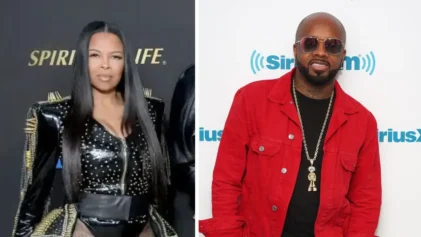
Jermaine Dupri is calling out the double standards of the rise of artificial intelligence artists decades after Gayle King’s viral interview.
For years, the So So Def label owner and producer has been vocal about his disdain for AI-generated singers replacing real talent. But this week, AI artist Xania Monet made history as the first of her kind to debut on a Billboard radio chart.

Behind the digital persona is 31-year-old Telisha “Nikki” Jones, a Black woman who openly admits she doesn’t have the vocal bandwidth.
“But you can’t sing!” Gayle King said to Jones during a “CBS Mornings” interview. “So in that sense, she’s not a real person.”
“‘But you can’t sing”
— Glock Topickz (@Glock_Topickz) November 5, 2025
– Gayle King tells Telisha “Nikki” Jones, creator of Billboard-charting AI artist Xania Monet, who maintains the AI is an extension of herself.
🎥: @CBSMornings pic.twitter.com/VJPiskX3mt
Jones admitted she writes all of Xania Monet’s lyrics, drawing inspiration from her own life and the experiences of her loved ones.
She views the AI artist as an extension of herself — even though she uses the SUNO music app to scroll through her written material and generate songs.
After her identity was revealed, Dupri took to X to call out the irony — likening today’s embrace of AI artists to the outrage over the infamous lip-synching scandal that ended R&B group Milli Vanilli’s career in the late ’80s.
On Nov. 6, Dupri wrote, “So let me get this right, years ago the industry found out that Milli Vanilli weren’t really the voices on their Grammy winning record and they were stripped of their Grammy, but now we’re getting ready to accept people who can’t even sing, creating songs for a fake person? How is this any different than Milli Vanilli?”
Fronted by Fabrice Morvan and Rob Pilatus, Milli Vanilli climbed to the top of the charts with songs like “Girl You Know It’s True,” and “Baby Don’t Forget My Number” in 1989.
But the pop duo’s success came crashing down in 1990 after the shocking revelation that they hadn’t sung a single note on their own records. According to Morvan, label executive Frank Farian had the pair sign a contract — one they admittedly never read — agreeing to lip-synch to vocals recorded by American singers.
Morvan, who is French, and Pilatus, who was German, saw their careers implode overnight once the truth surfaced. The Recording Academy went so far as to revoke Milli Vanilli’s Grammy Award for Best New Artist, marking one of the most infamous scandals in music history.
The Shade Room reposted Dupri’s post where people left their own comments and perspectives.
“Auto tune led us here,” said one person, referring to the use of the voice-altering tool, commonly used by the likes of other award-winning musicians including T-Pain, will.i.am, Kanye West, Future, and more.
One person suggested, “The only way to stop this is to not support the music, don’t stream it!!”
A third person on X replied to Dupri’s post with a different perspective and said, “If a human writes, produces and makes the beat and just uses Ai to perform the record, then it’s no different than what you do. I don’t see the issue.. anything outside of that scenario I’m not with.”
Dupri, the founder of So So Def Recordings, is a veteran songwriter and producer with a career spanning more than three decades. Throughout the years, he’s crafted hits and produced for some of the biggest names in music — including Mariah Carey, Usher, Nelly, Michael Jackson, Bow Wow, and many more.
Though Jones’ AI creation — and others like it — may not have Dupri’s support, she’s getting plenty of backing from another Grammy-winning producer, Timbaland.
In September, he shared a screenshot of his latest interview where he spoke about embracing AI in music. Under that Instagram post, one fan pushed back in the comments, writing, “People don’t want to listen to AI music; they just want to sell it. Actual audiences listen to connect with a human artist. That’s why none of your AI stuff is taking off. You’re a legend, and it pains me to see this chapter.”
Timbaland, who’s produced for icons like Aaliyah, Missy Elliott, and Justin Timberlake, replied, “You better check out Xania Monet who’s killing it — good music.”
He also introduced his own AI artist, TaTa Taktumi, part of a new genre Timbaland dubbed A-Pop (AI Pop). But after unveiling the creation, he faced heavy backlash, with some fans accusing him of tarnishing his own legacy by leaning too far into artificial intelligence.
But the way Timbaland explains it, a human is still largely involved with making these AI artists and their music.
He told Variety, “You still need the human element. I just use AI to add other elements to my music. It’s 80-85% human.”
“That’s the beauty of the tool — I’m still using musicians,” Timbaland said as he explained how he uses the device to make beats. “But I can also go, ‘Those strings need to be a Mellotron 1970 Chinese monotone’ or whatever, and it’s gonna give it back with that. And then I just take that as a stem and put it on my original beat.”
As for Jones’ digital alter ego, Xania Monet, she recently signed a $3 million deal with Hallwood Media. There’s also talk that the virtual artist could take the stage soon, with plans for live performances reportedly in the works.