President Donald Trump appeared unprepared when asked Wednesday whether he planned to suspend habeas corpus — the constitutional right allowing people to challenge their detention in court — deflecting the question to Homeland Security Secretary Kristi Noem during a White House event.
Trump took questions in the State Dining Room, where he hosted an “Antifa roundtable.” The president has repeatedly claimed that Antifa, a broad label for far-left activists, is responsible for unrest in U.S. cities such as Portland, Oregon. Referring to a phone call with Oregon Governor Tina Kotek, Trump previously said he was stunned that she disputed his claims about the city.
“I spoke to the governor, she was very nice,” Trump said last month. “But I said, ‘Well, wait a minute, am I watching things on television that are different from what’s happening? My people tell me different.’”
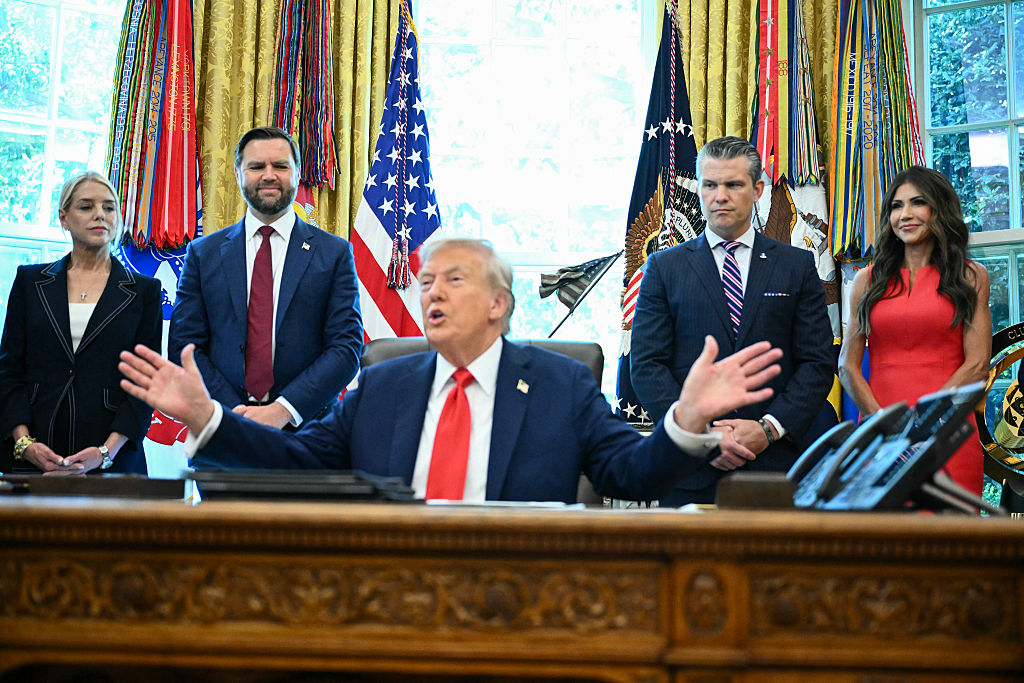
The confusion began when a sympathetic MAGA reporter asked Trump: “Have you given any more thought to possibly suspending habeas corpus to not only deal with these insurrectionists across the nation, but also to continue rapidly deporting illegal aliens?”
View on Threads
“Suspending who?” Trump replied.
“Habeas corpus,” came the follow-up.
“I don’t know,” Trump said. “I’d rather leave that to Kristi. What do you think?”
“Sir, I haven’t been part of any discussions on that,” Noem said.
Noem’s answer was telling.
Earlier this year, Noem badly flubbed a question about the meaning of habeas corpus during a Senate hearing — a receipt that continues to circulate online. When New Hampshire Sen. Maggie Hassan asked her to define it, Noem responded, “Well, habeas corpus is a constitutional right that the president has to be able to remove people from this country and suspend their right to–” before Hassan stopped Noem to correct her.
“Excuse me, habeas corpus is the legal principle that requires that the government provide a public reason for detaining and imprisoning people,” Hassan said.
Back at the White House on Wednesday, Trump abruptly tried to change the subject, pivoting to a question from CNN reporter Kristen Holmes — only to lash out at her instead.
“This is CNN speaking, by the way,” Trump told the room. “So, you know, this is one of the worst reporters that you’ll ever see. I don’t even want to take her question. It’s a waste of time.” Holmes had attempted to ask about a possible ceasefire agreement between Israel and Hamas, but Trump showed no interest in answering.
The exchange over habeas corpus quickly went viral, not only because of Trump’s confusion but because of the irony behind it: a president who has repeatedly flirted with overturning constitutional safeguards appeared not to understand one of the oldest rights in American law. Critics said the moment captured both Trump’s disregard for legal limits and his shaky grasp of the basic principles he’s been trying to upend.
“Trump has no idea what that means,” one user wrote on Threads, echoing what many others were saying across social media.
“Basically he doesn’t know what that means,” another voice declared on a clip shared by journalist Aaron Rupar. “The fact he even referred that to Kristi [Noem] rather than [Attorney General] Pam [Bondi] shows this lack of knowledge.”
Others broadened the criticism to include Noem. “I’d wager neither of them knows what habeas corpus means,” one person wrote.
Critics mocked Trump’s ignorance on the subject.
“So he thinks Habeas Corpus was a Roman general. Just like did Magna Carta die in vain I guess.”
Another added, “I’m laughing, but I should be crying to think that the president doesn’t have a clue.”
One person summed it up: “Trump is an absolute idiot.”
As far back as May, White House deputy chief of staff Stephen Miller had said the administration was “actively looking at” the possibility. “First, you know, President Trump has talked about potentially suspending habeas corpus to take care of the illegal immigration problem. When could we see that happen in the future?” a reporter asked Miller at the time.
“The Constitution is clear, and that, of course, is the supreme law of the land, that the privilege of the writ of habeas corpus can be suspended in time of invasion,” Miller replied. “So, it’s an option we’re actively looking at.”
If carried out, such a move would mark one of the most dramatic expansions of presidential power in modern history — effectively allowing the administration to detain people indefinitely without judicial review.
The Constitution permits suspension of habeas corpus only in cases of rebellion or invasion “when the public safety may require it.” According to the National Constitution Center, the United States has suspended the writ just four times: during the Civil War, during Reconstruction in South Carolina, in the Philippines amid a 1905 insurrection, and in Hawaii after Japan’s 1941 attack on Pearl Harbor.
Miller has claimed that undocumented immigration qualifies as an “invasion,” invoking language similar to that used by Trump in March when he cited the Alien Enemies Act to expedite deportations of Venezuelan nationals allegedly tied to the gang Tren de Aragua. But two federal judges — including one appointed by Trump — ruled that rationale unlawful, finding no evidence the U.S. was being “invaded.”
“Miller also doesn’t deign to mention that the near-universal consensus is that only Congress can suspend habeas corpus — and that unilateral suspensions by the President are per se unconstitutional,” Georgetown law professor Steve Vladeck wrote on his Substack, according to ABC News. “He’s suggesting that the administration would (unlawfully) suspend habeas corpus if (but apparently only if) it disagrees with how courts rule in these cases. In other words, it’s not the judicial review itself that’s imperiling national security; it’s the possibility that the government might lose. That’s not, and has never been, a viable argument for suspending habeas corpus.”
The historical precedent underscores Vladeck’s point. President Abraham Lincoln’s Civil War suspension of habeas corpus was ruled unconstitutional by then–Chief Justice Roger Taney, who emphasized that the power rests with Congress under Article I. Lincoln eventually sought congressional authorization as the war continued.
Critics say Trump’s offhand deflection — and Noem’s confusion — highlight a deeper pattern in his administration: claiming sweeping powers while showing little grasp of the constitutional limits that restrain them.


