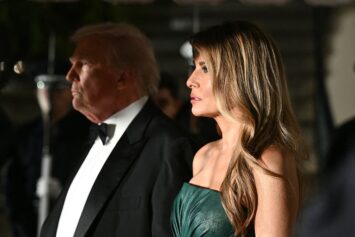
Donald Trump’s wife, Melania Trump doesn’t talk much, but when she does, people stop and listen—sometimes for reasons she’d rather they didn’t. On Sept. 23, the first lady took the stage with grand ambitions to unveil a sweeping new initiative, but her polished mission was quickly overshadowed by something far more trivial and infinitely more viral.
The first lady’s pronunciation struggles had social media in stitches as she stumbled over her words.

Trump introduced “Fostering the Future Together,” a coalition aimed at enhancing children’s well-being through education, innovation, and technology during the 80th session of the U.N. General Assembly.
During her speech, she said, “Our cities’ lights, while time feels frozen. Behind each flickering light is a family at home, where parents work tirelessly to unlock brighter futures for their ‘chil-eedrun’. We have all stood there, gazing, asking ourselves: What can I do?”
Melania’s distinctive accent from Slovenia and occasional linguistic stumbles became the focus rather than her humanitarian message. When the video of her speech hit the internet, Threads users were already having a field day with her speech patterns.
“Surely she’s been in America long enough to speak better English,” one person wrote, encapsulating the sentiment that would dominate online discussions.
The criticism wasn’t entirely unfounded, as Trump’s pronunciation of “children” as “chil-eed-run” became an instant joke, with users dissecting every syllable of her address.
Taking aim at Melania and her husband, one user chimed in with “Neither one of them can read.”
View on Threads
“Nope…I cannot listen to her,” someone else wrote, refusing to move past her broken speech.
The online commentary grew increasingly pointed as more people weighed in on the first lady’s linguistic delivery.
“She barely speaks english. Must not use it much daily. Only the BEST hypocrisy,” someone else wrote, highlighting what many saw as a contradiction.
The irony wasn’t lost on observers who remembered President Trump’s recent Executive Order 14224 from March 1, which designated English as the official language of the United States.
The order maintained that if everyone spoke English, it would foster national unity. This was a direct push for agencies to minimize non-essential multilingual services while prioritizing English-language education and assimilation.
Critics blasted the White House for hypocrisy, noting the first lady’s struggles with English pronunciation while the administration pushes English-only policies.
Adding another layer to the cultural conversation was President Trump’s own UN address that same day, where he spoke about protecting nations from being “overwhelmed by people they have never seen before, with different customs, religions, and everything else.”
His emphasis on maintaining cultural boundaries while his wife faced scrutiny for her own linguistic differences created yet another talking point for those following the story.
The day’s awkward moments weren’t limited to speech patterns.
Video footage captured Trump and Melania encountering a mechanical mishap when the UN headquarters escalator suddenly stopped working just as they stepped onto it. The couple found themselves walking up the remaining steps while cameras rolled, with Trump later telling a greeter, “Your escalator just broke.”
The moment provided additional fodder for social media users already primed to find fault with the couple’s public appearances.
Her launching this initiative comes weeks after the first lady appeared particularly tired during various events, including what some described as her seeming to doze off during service at the Pentagon, where Trump had to gently nudge her awake.
The combination of Melania’s apparent fatigue and speech difficulties led some to speculate about her overall engagement with her public role. The episode demonstrates how quickly substantive policy announcements can be derailed by superficial concerns in our social media age.