President Donald Trump set off a wave of confusion and outrage Monday at a White House press conference, claiming that Tylenol use during pregnancy is driving America’s autism rates and struggling to pronounce “acetaminophen,” which quickly became a punchline on social media.
At one point, he even argued that Cuba and Amish communities have “no autism” because they lack access to the pain reliever.
Trump’s struggle to pronounce acetaminophen turned into an awkward pause at the podium. “Ah-se-der… well, let’s see how we say that. Ascenem – enophin. Acetaminophen. Is that OK?” the president asked, before plowing ahead.
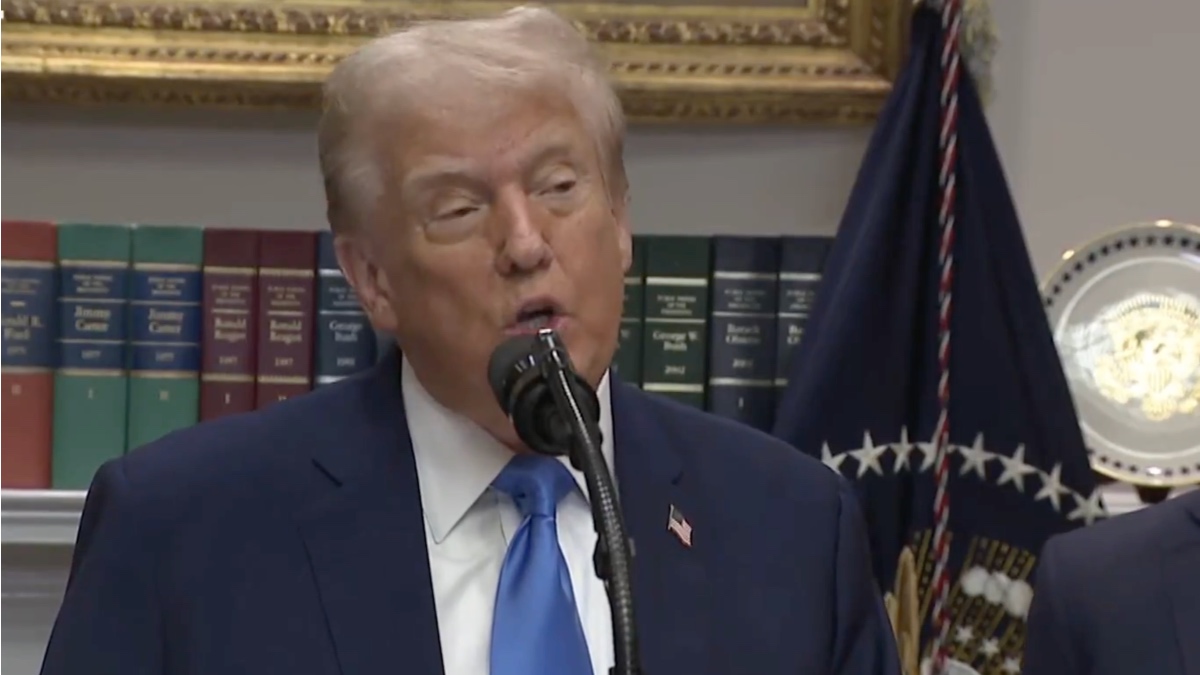
“Taking Tylenol is not good — I’ll say it: It’s not good,” he said, without evidence.
The remarks sparked immediate backlash online, with many people calling Trump’s claims bogus and absurd.
On X, Rep. Jasmine Crockett brutally mocked the president’s pronunciation of acetaminophen.
“WIN: Kimmel is back on the air! LOSS: It is clear that the person running the country is ill equipped. Maybe hooked on phonics would be helpful. uh-see-tuh-MI-nuh-fuhn (acetaminophen); they know that he reads on a second grade level. They were wrong for giving him that SAT word with no heads up or is the question whether or not his mother took Tylenol when she was pregnant with him?” she posted.
On Instagram, one critic commented on a video of the press conference, saying: “It’s pronounced Epsteinaminophen.”
Other critics zeroed in on Trump’s claims about Cuba and his repeated stumbles at the podium.
“The president of the United States has just said Cuba has almost no people diagnosed with autism because they can’t afford Tylenol,” one critic blared on Threads. “There has never been a more ignorant president of the United States. It’s embarrassing. I’m not even American, and I have thirdhand embarrassment on behalf of non-MAGA Americans. How is this real?”
Independent journalist Aaron Rupar delivered one of the most widely shared reactions: “Trump hyped a huge autism announcement for months then followed through today with a press conference where his brain leaked out of his ears for an hour while he couldn’t pronounce ‘acetaminophen’ and yelled ‘DON’T TAKE ASPIRIN’ over and over. Congratulations, America.”
Joining Trump for the announcement were Health and Human Services Secretary Robert F. Kennedy Jr., FDA Commissioner Dr. Marty Makary, NIH Director Dr. Jay Bhattacharya, and CMS Administrator Dr. Mehmet Oz.
Trump said the Food and Drug Administration would begin warning doctors that acetaminophen, which is sold under the brand names Tylenol and others, “can be associated with a very increased risk of autism.”
“They are strongly recommending that women limit Tylenol use during pregnancy unless medically necessary,” Trump said.
Trump went further, saying, “communities without access to the medicine have no autism,” and suggesting that in the United States, autism now affects “one in 12 boys.”
Current CDC estimates place the rate at about 1 in 31 children.
The president also told Americans to avoid giving acetaminophen to babies, while reviving the debunked claim that vaccines may contribute to autism. “It’s too much liquid, too many different things are going into that baby,” he said.
Trump repeatedly pointed to the Amish community as further evidence of Tylenol’s link to autism. “The Amish community has virtually no autism,” he said, crediting that to women not taking medications like Tylenol during pregnancy. He extended the claim abroad: “Look at Cuba — they can’t afford Tylenol, and they don’t have autism.”
Trump thanked Kennedy for “bringing autism to the forefront of American politics, along with me.” Kennedy, a longtime anti-vaccine activist, nodded as Trump added, “We understood a lot more than a lot of people who studied it.”
Medical and autism advocacy groups condemned the White House event.
“Today’s White House event on autism was filled with dangerous claims and misleading information that sends a confusing message to parents and expecting parents and does a disservice to autistic individuals,” said Dr. Susan Kressly, president of the American Academy of Pediatrics. “There is no single, root cause of autism, and there is no single medication that will give every autistic child or adult what they need.”
Colin Killick, executive director of the Autistic Self Advocacy Network, said the claims left him and other experts flummoxed.
“It’s wild. They are playing loose with facts to show the appearance of a connection rather than doing responsible science.”
Professional medical organizations said they were blindsided by the announcement. According to CNN, the American Academy of Pediatrics, the March of Dimes, EveryCure, and the American College of Obstetricians and Gynecologists all said they had not been consulted.
Kenvue, the maker of Tylenol, issued a statement urging expectant mothers to speak with their health professionals before taking any over-the-counter medications.
Meanwhile, the FDA announced it had approved prescription leucovorin — a high-dose calcium folinic acid typically used for cancer patients — as a treatment for autism in children, calling it the first FDA-recognized treatment for autism. The agency also reinstated approval of Wellcovorin, a branded version once marketed by GSK.
Trump described autism as a “horrible, horrible crisis” and “one of the most alarming developments in history.” He urged faster research into its causes, while Kennedy promised all agencies under his leadership would study the condition.
Still, medical experts stressed there is no evidence to support Trump’s central claim. Decades of research have found acetaminophen safe during pregnancy when taken as directed.
While speaking, Trump admitted he was not precise with his language on the subject. Still, he repeated the same warnings and returned to a single refrain for expectant mothers: “Don’t take Tylenol.”
“If you can’t tough it out,” Trump said, limited use of acetaminophen might be necessary. But “ideally you don’t take it at all,” he added, in a rambling press conference that at times conflated vaccine and painkiller use, citing both unconfirmed rumors and personal suppositions that both might be harmful to women and babies.
“It looks like you’re pumping it into a horse,” Trump said of multiple vaccinations given to children. “The Amish, for example, have no autism,” he claimed, despite research showing that autism does affect Amish communities. He went on to argue that there are “no cases of autism in Cuba,” a claim contradicted by medical data and international reporting.
“There’s no downside,” he maintained. But his recommendation cut against longstanding medical guidance. Pregnant women are already advised to avoid other anti-fever drugs such as aspirin and ibuprofen, since those can pose risks to fetal development. Acetaminophen remains the standard option for treating pain and fever during pregnancy.
The Society for Maternal-Fetal Medicine reiterated its position after the president’s remarks. The group recommends acetaminophen when medically necessary and stresses that untreated fever can cause serious harm, including miscarriage, birth defects, or premature birth — especially early in pregnancy.
Trump’s comments once again placed him at odds with established medical consensus, raising fears among doctors that expectant parents could be confused or misled. “When misinformation comes from the highest levels, it risks real harm,” one maternal-fetal medicine specialist said in response to the announcement.
The messages from Kennedy and the FDA on Monday were more measured than Trump’s repeated warnings not to take Tylenol during pregnancy or give it to babies.
Kennedy said HHS will launch a nationwide public service campaign to inform families about the risks and encourage careful use. Clinicians, he said, should use acetaminophen for fever and pain in pregnancy only when necessary, “for the shortest necessary duration and only when treatment is required.”
The FDA outlined a narrower approach. The agency stated that it is initiating the process of updating the safety label on acetaminophen products and will send a letter to physicians, emphasizing that the decision “still belongs with parents.” While acknowledging that some studies have described an association, the FDA added, “a causal relationship has not been established.”
Tylenol maker Kenvue responded forcefully. The company said it “strongly disagrees” that acetaminophen causes autism and is “deeply concerned about the health risks and confusion this poses for expecting mothers and parents.”
“Acetaminophen is the safest pain reliever option for pregnant women as needed throughout their entire pregnancy,” Kenvue said in a statement. “Without it, women face dangerous choices: suffer through conditions like fever that are potentially harmful to both mom and baby or use riskier alternatives. High fevers and pain are widely recognized as potential risks to a pregnancy if left untreated.”


