A video showing three white teenagers dressed in prison outfits and blackface was reposted online, drawing fresh attention, outrage, and debate about hate crimes.
The clip shows the kids in a shopping center dressed in prison uniforms and blackface with several other white teenagers in their company, including one dressed as a SWAT law enforcement official.
A woman recording the teens chastises them in the background, telling them, “You guys are never going to get into a college; you guys are not going to get any scholarships because this is a hate crime.”
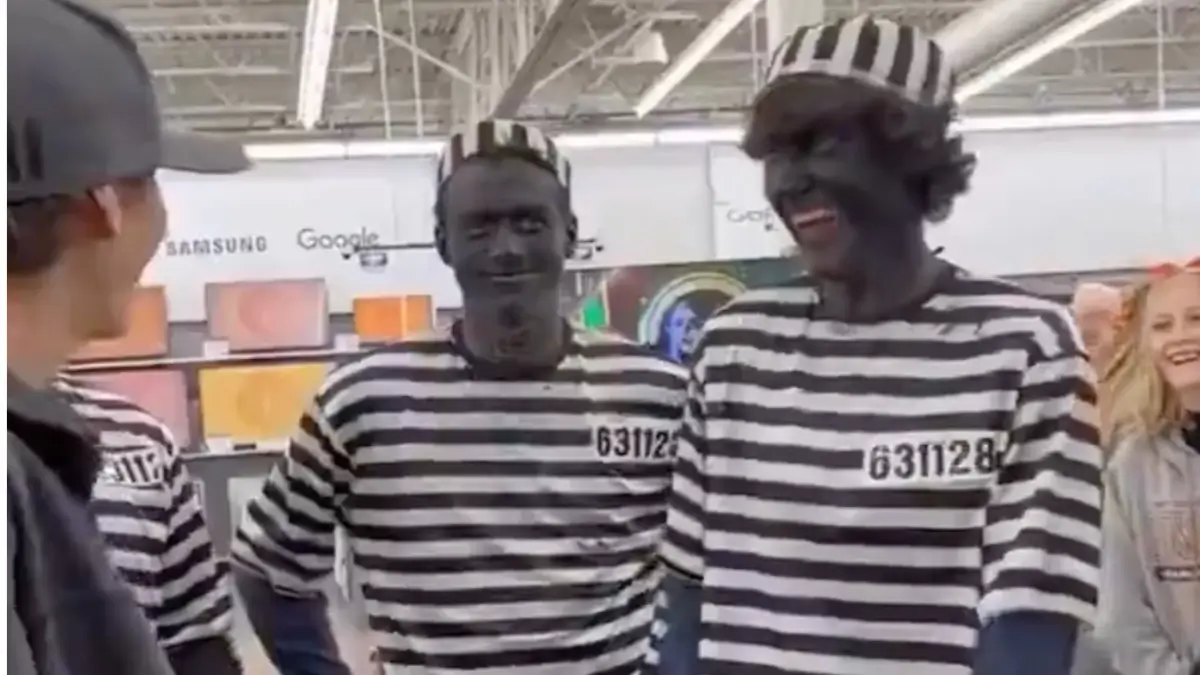
One teen responds with, “We all dropped out of high school. It’s OK.”
After being reshared on X, the video drew millions of views and thousands of comments. While many people were stunned by the teens’ brazen behavior and show of racism, several trolls found the outfits “hilarious.”
Others debated against the hate crime accusation, arguing that the costumes can’t be considered a criminal offense. Some people didn’t even deem them racist.
“There is no underlying crime and they did not threaten anyone with violence. Hence, no hate crime here,” another X user wrote in the comments.
Starting in the 1800s, white performers in the U.S. used blackface to imitate and ridicule enslaved Africans on Southern plantations. The practice became widely popular in American theater and continued through the 20th century. Actors who donned blackface in these performances would characterize Black people as lazy, ignorant, superstitious, hypersexual, and prone to thievery and cowardice. These depictions perpetuated the stereotypes that still detrimentally impact race relations in the U.S.
The clip of the teens originally went viral in 2022 and sparked massive outrage online. The teens were reportedly recorded inside a Walmart in Cedar City, Utah.
After local police launched an investigation in November 2022, they determined that the teens didn’t commit any crimes.
“Investigators interviewed multiple subjects, collected videos and obtained other evidence,” but no crimes were committed,” Cedar City Police wrote in a release. “The Cedar City Police Department condemns the insensitive and inappropriate acts of those involved. We promote inclusivity and acceptance.”
The Cedar City and Iron County Attorney’s Offices also declined to prosecute.
“Both offices agreed with the investigative team that there is no evidence of any crime, and therefore, nothing to prosecute,” the release states.
Utah state law defines a hate crime as a criminal offense committed against a person or property that is motivated by the offender’s bias or prejudice against the victim’s sexual orientation, religion, gender, or skin color. These crimes can take many forms, including physical assault, vandalism, and verbal harassment, and they are denoted by the intention to intimidate and terrorize not only the victim but also the larger community to which the victim belongs.
The state legislature defines “intimidate or terrorize” as acts that cause a person to fear for their physical safety or damage the property belonging to that person.
Utah Gov. Spencer Cox weighed in at the time the video circulated on social media, saying, “We strongly condemn racism in all its forms, and we call on every Utahn to reject such offensive stereotypes, slurs, and attitudes. We must do better.”


