South African delegates asserted that Palestinians are suffering from a regime of apartheid as a result of Israel’s occupation of the region.
Representatives from South Africa stated that the occupation is “inherently and fundamentally illegal” during the second day of hearings at the International Court of Justice about Israel’s control over the West Bank, Gaza, and annexed East Jerusalem.
The hearings come after the United Nations General Assembly requested the Netherlands-based court in 2022 to make a non-binding advisory opinion on the legality of Israel’s policies in occupied Palestinian territories.
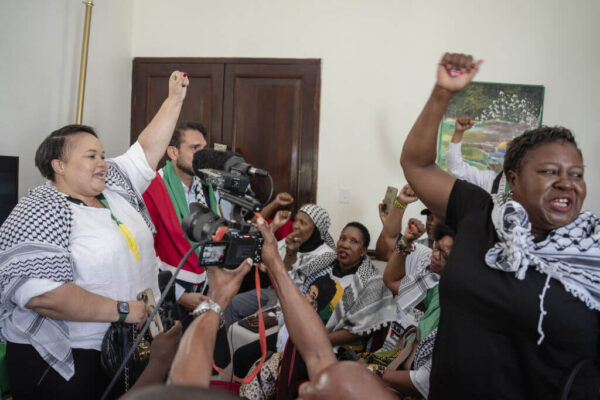
“We as South Africans sense, see, hear and feel to our core the inhumane, discriminatory policies and practices of the Israeli regime as an even more extreme form of the apartheid that was institutionalized against Black people in my country,” Vusimuzi Madonsela, South Africa’s ambassador, told the ICJ’s 15-judge panel.
More than 50 countries, alongside three international organizations, are set to make arguments during the hearings, which are expected to last until Feb. 26. Much of the international community considers Israel’s occupation illegal, something codified as long ago as November 1967 through the United Nations Resolution 242.
“It is clear that Israel’s illegal occupation is also being administered in breach of the crime of apartheid… It is indistinguishable from settler colonialism. Israel’s apartheid must end,” Madonsela also stated.
Israel is not participating in the hearings. Prime Minister Benjamin Netanyahu refused to recognize their legitimacy. His office said they were “designed to harm Israel’s right to defend itself against existential threats.”
Israel took control of the West Bank, east Jerusalem, and the Gaza Strip in the 1967 Mideast war, according to AP. The government has established settlements on the West Bank that are home to 500,000 Jewish settlers. The Palestinians seek an end to the occupation. United Nations Resolution 2334, which was passed by the Security Council in 2016 by a 14-0 vote with the United States abstaining, underscores the international community’s position on the illegality of the settlements.
The United States government still refuses to take a hardline stance against the current conflict. In their appearance at the hearings, U.S. officials warned that an advisory opinion from the ICJ could impede peace efforts rather than advance them if it’s not properly written.
“A movement toward Israel’s withdrawal from the West Bank and Gaza requires consideration of Israel’s very real security needs,” State Department official Richard Visek told the court.
The U.S. has vetoed three U.N. Security Council resolutions so far calling for an immediate ceasefire in the Gaza Strip. This month, the Biden administration called Israel’s military offensive “over the top” and stated that civilian suffering must stop.
The court’s advisory opinion isn’t expected for months.
Gaza health ministry officials reported that more than 29,000 Palestinians have died as a result of Israel’s ongoing military campaign against Hamas.
South Africa launched a separate case to hold Israel accountable for the war, accusing the country of genocide against Palestinians — allegations the Israeli government strongly denied. The ICJ issued an order last month directing Israel to start enacting “provisional measures” to provide aid to Palestinians and mitigate the bloodshed.


