A popular Lowcountry seafood restaurant owned by a prominent Black chef in Asheville, North Carolina, was targeted in an apparent racist attack when hooligans bum-rushed the business at closing time, cut the power and defaced the entrance before fleeing.
No physical violence was reported in the Feb. 3 incident at the Good Hot Fish, but the invasion left renowned millennial chef Ashleigh Shanti stunned just two weeks after she opened the Gullah-inspired dining spot in Asheville’s South Slope neighborhood.
Witnesses said the small mob ambushed the store and “shut the power off to our dining room while our last guests were enjoying their dinner,” Shanti fumed in an Instagram post following the raid.
More than a week later, no arrests or suspects have been announced.
On Facebook, Shanti described the episode as “racists doing what they do best.”
“They then ran away, like cowards, when confronted by a guest and an employee but not before outfitting our entrance with this disgusting sticker,” she said, referring to an offensive decal the group stamped to the front wall of the business, which read: “How to ruin a white city,” and contained references to the “N-word,” as well as a star of David — the symbol of Judaism.
The restaurant remains open for business, and in light of the incident, Shanti said she felt more determined than ever to make a positive impact in the community through her food.
“We’ll go even harder,” she said on Instagram. “I’ll keep minding my own Black business and spreading love through serving good ass food for my people.”
The business is modeled after a fish camp — a casual dining establishment known for serving fried fish and seafood dishes that are extremely popular in coastal areas throughout the Southeast.
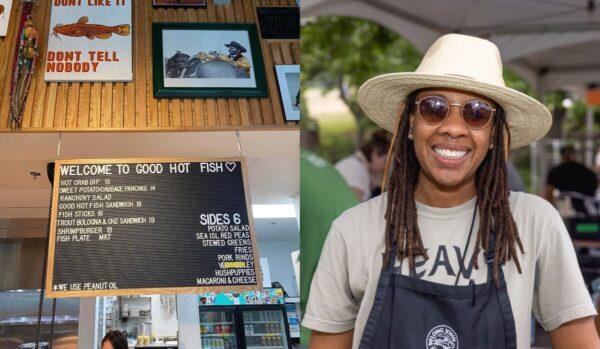
The menu at Good Hot Fish includes fish sandwiches, hot crab dip, Sea Island red peas, hush puppies, and shrimp burgers.
Two years ago, while traveling the country to promote her Asheville business, Shanti told Eater Carolinas, “There is something to be said about working for yourself and wanting ownership of your stories. Falling in love with a community and pouring into it. I just want to replicate that business of a modern-day fish camp.”
Customers who wander into Good Hot Fish are treated to a rich tapestry of art, music, photographs and magazine covers that celebrate Black history.
However, the Black cultural display at Good Hot Fish stands in stark contrast to the surrounding brewing district in Asheville, which predominantly caters to white consumers.
Academic experts said this racial dynamic ultimately led to Shanti’s business being singled out.
“Her character of a chef is top-notch, but because of her color, her gender, and sexual orientation, she is judged to be less,” said Mars Hill University history professor Jonathan McCoy, who explained the racially charged episode to the Citizen-Times.
The Asheville Police Department confirmed to Atlanta Black Star that an official report had been filed in the incident and that an investigation was underway.
“We are working with the business owner and surrounding businesses to gather more information and further evidence in the hopes of identifying the suspects in this incident,” department spokesperson Samantha Booth said, noting the department would release an official copy of the police report on Monday.
Shanti said she was away in Raleigh at the time of the incident, while her wife, Meaghan Shanti, was on duty.
Meaghan told local news outlet Eater Carolinas that she noticed the group of men down the street tampering with a power breaker before the lights went out at Good Hot Fish.
As the men ran off, Shanti recounted that an employee and a customer shouted blame at the group, prompting one of the culprits to return, restore the power, and flee again.
Shanti’s latest solo endeavor, Good Hot Fish, marks her return to the bohemian haven of Asheville, nestled in the Blue Ridge Mountains, where her auspicious career began just six years ago.
She made a big splash in the city’s food scene in 2018 when she became head chef of Benne on Eagle, a high-end eatery in the historically Black neighborhood known as The Block.
She worked there until 2020 and was nominated for the coveted James Beard Award for her culinary depth, which ultimately earned her a spot on Season 19 of Bravo’s “Top Chef,” bringing her global fame in 2022.


