Members of Howard University’s faculty have threatened to go on strike next week over what they call unfair work conditions and low pay for non-tenured, full-time teaching faculty and adjunct professors. The educators were joined by their colleagues, students, and alumni during Wednesday, March 16, protest on campus.
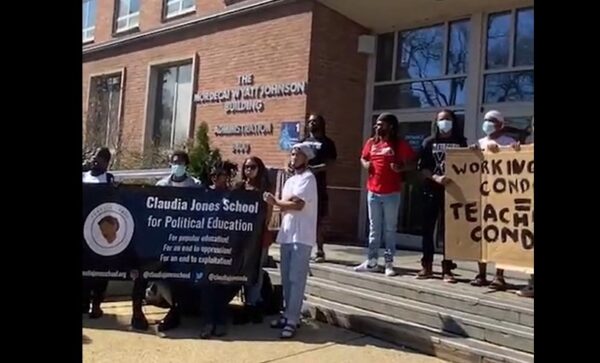
The premier HBCU has not reached a work agreement with the Service Employees International Union (SEIU) Local 500 for its campus’ 150 non-tenure-track, full-time teaching faculty and 200 adjunct professors, a collective identifying themselves as The Howard Teaching Faculty Union (HTFU).
On Wednesday, one of the alumni named Thomas attended the demonstration and spoke about his history with the school. Thomas said, “I was born colored and negro, but I became African-American at Howard University.”
After sharing how he and his wife were students who participated in many protests on campus, he explained to the assembly why it is imperative for everyone to “support the union, support organized people, support having decent wages, support a wage that can raise your people.”
Teachers and students held up signs saying, “Working Conditions = Teaching Conditions” and “We are not disposable.”
Two female teachers were among the many speakers. Their stories were unique as they both claimed that when they were pregnant the university gave them a hard time when negotiating their maternal leave.
They said while the school gave them a lot of leave, the university was not willing to give them the money they needed. Now, with infants to raise, the two English teachers, who have taught for three years over 300 students, contend their salaries are “too low to afford child care.”
A flyer circulated about the dispute states the group has been negotiating with the administration for almost three years.
The fact sheet explains how Howard’s non-tenure-track lecturers and adjunct faculty “teach over 2,000 courses per year,” and the “lecturers have not received a raise in over 5 years.”
At the same time, it reports, Howard’s tuition has been raised 19% of the past five years and the school’s president receives a salary of $1.649 million, adding he makes over a half-million more than the American University president.
Based on the information presented by the HTFU, based on the cost of living, these educators working at Howard are the lowest-paid HBCU academicians in the United States, and some have to work as many as four extra jobs to “survive” in the Washington area.
The union is fighting for adjuncts to receive the same pay as their full-time teaching counterparts since students pay the same tuition amount for the course credits (regardless of the teacher’s credential). They would like the opportunity to apply, provided they are qualified, for full-time NTT lecturer positions when they become available and the go-ahead to teach three courses per semester, which will allow them to qualify for health insurance through the school.
The full-time faculty members are fighting for different issues, in addition to a pay raise, including changing the seven-year rule, which currently determines if the educator will be hired again, year after year.
Contingent Faculty leader and Howard alumnus Cyrus Hampton stated, “The University leadership has made clear that a better teaching environment and better learning environment is unimportant to them.”
“They have left us no choice but to strike because of their continued bad-faith bargaining,” continued the full-time teacher in the university’s English department.
Marcus Alfred, associate professor in physics and the president of Howard’s Faculty Senate Executive Council, said, “The contingent faculty are important to student learning, their demands are just, they are not alone, because students, alumni, and tenured faculty stand with them, and they will win.”
In a statement, Howard University’s administration said, “Our commitment to a peaceful bargaining process has not changed, and we will continue advancing good faith efforts to reach an agreement with the union and address the needs of adjunct and non-tenure-track faculty and the University.”
“We have made proposals for wage increases for union faculty and continue to bargain in good faith,” the statement continued. “Howard faculty play a vital role in our community. We will continue working together with our faculty to ensure their success and the success of Howard students.”
Last year, Howard University students also organized protests targeting the administration’s maintenance operations.
For more than a month, students working in conjunction with the Live Movement staged a demonstration outside of the Blackburn University Center by sleeping in tents in demonstration of what they considered poor housing conditions and the lack of student representation on the Board of Trustees. Some 150-plus students participated in the protest.
The protest started on Oct. 12, 2021, and ended after student protesters and the university came to an agreement in November.
As mentioned by Thomas at the March 16 protest, students have exercised the power of protest by generations. In 2018, students executed a nine-day occupation of campus administration building, in efforts to move the administration to revise the school’s sexual assault policy, a review a policy allowing campus police officers to carry weapons on campus and the creation of a campus food bank for students.


