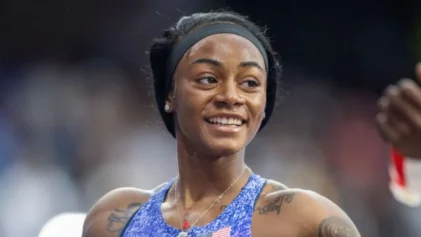
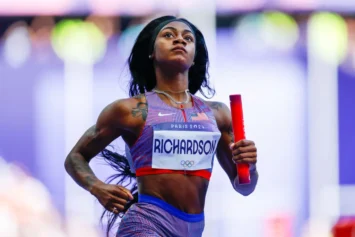
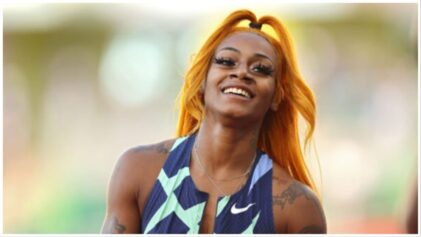
Sha’Carri Richardson is finding the light after a dark year of hardships.
The track star made headlines for her performance in winning the women’s 100-meter final with a time of 10.86 seconds at the 2020 U.S. Olympic Trials, which took place in 2021. However, Richardson was disqualified from the Tokyo Olympics after testing positive for marijuana shortly after the 100 final last June.
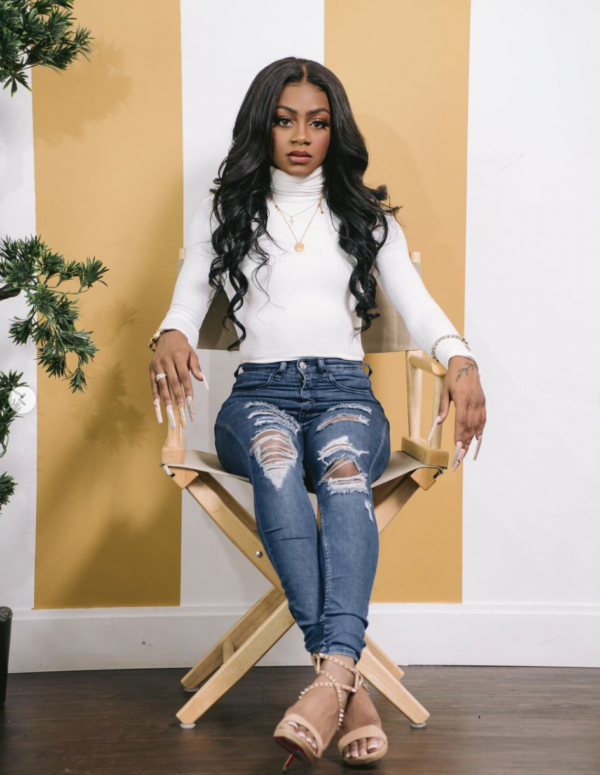
Weeks ago she complained that a 15-year-old Russian figure skater who also tested positive for a banned drug was allowed to continue competing in this month’s Beijing Winter Olympics, which Richardson implied was discrimination. On top of everything, she’s dealt with online trolls commenting on her hair, nails, and appearance as a Black woman.
So how does this queen keep her confidence so high? Richardson tells Teen Vogue “just the fact of being in a community, being from South Dallas, that is predominately Black.”
Despite a few hardships, Richardson was able to hold on to the Nike deal she secured in 2019 and starred in a Beats by Dre commercial edited by Kanye West in July 2021. She said she has forgiven herself for the incident by “acknowledging it first, acknowledging the situation for what it is, acknowledging my responsibilities in it, and talking about it to the people I feel like it impacted besides myself.”
She says, “When I had the entire situation of being banned from the Tokyo Games, the people who I talked to first were the people who I felt like were with me the most on the journey. I apologized to them first. I felt like they had to hold my shame as well, in a way, or my guilt, in a way.”
But she still describes being an outspoken Black woman in America as a gift and a curse.
“If you take away the ‘Black’ in front of the ‘woman’ and another woman reacts the same way, it’s not considered as ‘sassy,’…[or] ‘aggressive,’” says Richardson, before paraphrasing a quote from Malcolm X. “One of the most powerful Black men said it, but the most disrespected person in the United States is [the] Black woman.”
The former LSU star uses her social media platforms to present herself as redefining the narrative about Black female athletes, who could not be as outspoken in the past. On Twitter, she shares race-related posts and other topics.
“When I’m off the track, I experience things just like … any other woman, any other Black person would experience. So, to me, not to acknowledge that would be part of the problem,” she adds. “I would be part of the reason why there’s no change. The fact that I say that I’m Black before an athlete, I really stand on that.”
More Stories from Our Partners:
The Best and Worst States for Black Entrepreneurs In 2022