

Mary J. Blige opened up about a massive medical blind spot that she lived with until she was 40, in hopes of motivating more Black women to educate themselves and take action sooner.
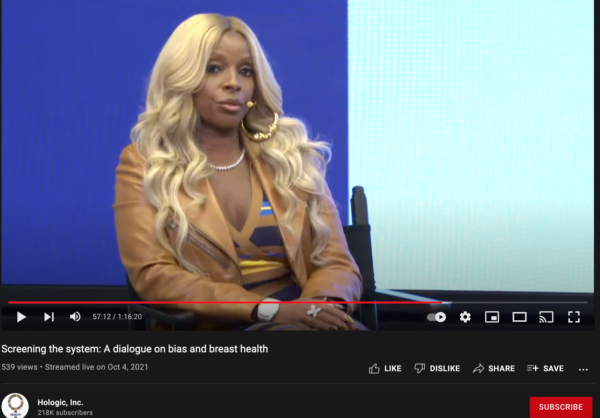
The “No More Drama” singer, 50, joined medical technology company Hologic’s “Screening the System: A Dialogue on Bias and Breast Health” discussion as a panelist on Oct. 4, along with moderator and journalist Sheinelle Jones, Chicago-based physician Dr. Arlene Richardson, and Black Women’s Health Imperative president and CEO Linda Goler Blount.
The conversation touched on the importance of not only receiving mammograms but openly discussing health history and medical knowledge among families, instead of living in fear or shame when it comes to knowing your breast cancer status, a point that the R&B singer made when she revealed that she had no knowledge about breast cancer or mammograms until it was time for her to receive one.
“I didn’t know about breast cancer or mammograms until I was 40, and I was in the music business and I was trying to take care of myself,” she shared. “My body started talking so I started listening. I found out about a mammogram at the GYN. They don’t discuss this as children. They tell us, ‘Go get a mammogram.’ We learn about this as we get older.”
The nine-time Grammy-winning artist explained that she feels that a lack of communication between family members is the culprit for her ignorance, and that of many others. “My aunt died from breast cancer. My grandmother died from cervical cancer, and one of my aunts just died from lung cancer. … What happens is they end up in the hospital and … there’s no one in our families speaking about it when we’re younger,” she said when asked why she decided to help raise awareness for the disease.
“They don’t speak about it, and that’s why they end up in the hospital with two weeks to live, and now you know about it,” she explained. “That’s why it’s extremely important to me, because I’m sure it’s going on in a lot of African American homes, in our culture. … I’m here to let women know, no that matter how scary it is or who’s telling you it’s scary, take care of you. Take care of your health. … I’m here for us. … Somebody has to help us in our communities get the proper treatment. I do it annually now that I found out what it’s about.”
Fans were shocked to learn of Mary’s late lesson in life, but also noted that it shines a light on the lack of education and access to proper medical care that still exists within the Black community.
“All kinds of hateration and holleration coulda been going on in her breastery🙄”
“proof that there is lack of medical education in the black community”
“This isn’t something to make fun of her about. We all know this type of care isn’t presented to black women the way it is to white women.”
Based on data from 2018, 74% of Black women ages 50-74 who had a mammogram in the past 2 years, the highest rate when compared to women of white, Hispanic, Asian American, and American Indian and Alaska Native descent. Black women have a lower rate of new cases than white women, however, the mortality rate is higher due to access to follow-up care after an abnormal mammogram, among other factors, according to Komen.org.
The Hologic panel’s experts recommend that women begin their yearly mammogram exams at age 40 to allow for early detection.


