As a father, Barack Obama has been open about acting as a driving force in his daughters’ lives. Yet parents are not the only entities that rear children, and the former president recently revealed that he has communicated to Sasha and Malia about society’s influence and expectations on the expectations for men.
In a clip from his new podcast with Bruce Springsteen, “Renegades: Born in the USA,” entitled “Masculine Qualities,” Obama discusses how the male psyche has been shaped by outside forces and in some cases passed down from father to son.
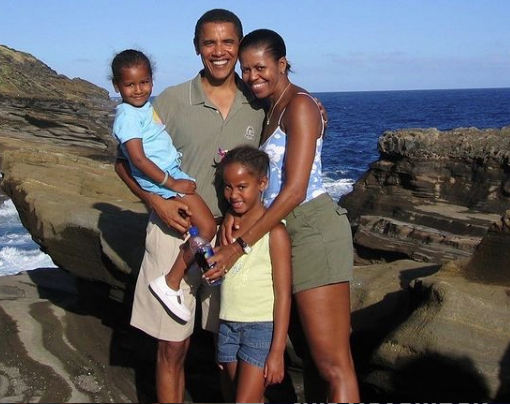
“I talk to my daughters’ friends about boys growing up, and so much of popular culture tells them that the only clear, defining thing about being a man, being masculine, is you excel in sports and sexual conquest,” he said.
“And violence, right? Those are the three things, and violence, if it’s healthy at least, is subsumed into sports,” he continued. “Later, you add to that definition making money, right? How much money can you make?”
Obama conceded that that on occasion, society has reinforced some of the more positive aspects of the male identity, by ingraining in them the importance of “handling their business.”
“There were some qualities of the traditional American male, that are absolutely worthy of praise and worthy of emulating that sense of responsibility,” he said. “Meaning you’re willing to do hard things and make some sacrifices for your family or for future generations. The greatest generation showed that again and again. And that — handling your business. That sense of responsibility of being an adult.”
However, he says that “there’s a bunch of stuff in there that we did not reckon with” and that we are now seeing the results of it with #MeToo, equal pay for women, and domestic abuse and violence. Obama also put the onus on fathers for perpetuating some of the dangerous lessons about masculinity that are learned.
“There was never a full reckoning of who our dads were, what they had in them, how we have to understand that and talk about that, what lessons we should learn from it. All that kind of got buried.”
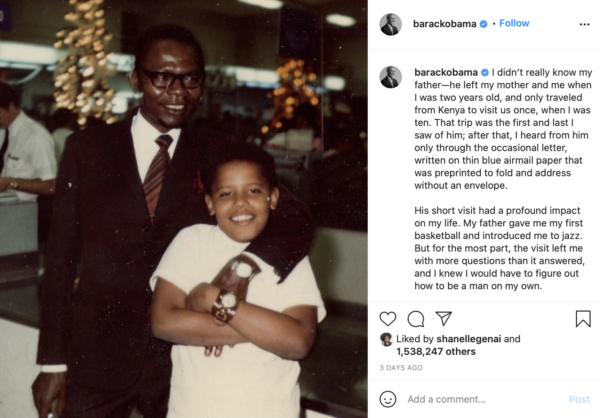
Obama has talked at length about the absence of his own father in his childhood, making Barack Obama Sr. the central figure of his memoir, “Dreams of My Father.”
“It’s no secret that my father was a troubled person. Anybody who has read my first book, ‘Dreams from My Father,’ knows that, you know, he had an alcoholism problem, that he didn’t treat his families very well,” he said in a 2009 CNN interview.
“Obviously it’s a sad part of my history and my background. But it’s not something that I spend a lot of time brooding over.”
Instead Obama used his experiences to lift up others, extolled the virtues of strong, deliberate parenting, and of teaching children that their worth does not come from the media. During his 2008 Father’s Day speech to Apostolic Church of God in Chicago, he recited a powerful sermon that resonated with the themes of the holiday.
“It’s up to us — as fathers and parents — to instill this ethic of excellence in our children,” Obama said. “It’s up to us to say to our daughters, don’t ever let images on TV tell you what you are worth, because I expect you to dream without limit and reach for those goals.”
“It’s up to us to tell our sons, those songs on the radio may glorify violence, but in my house we give glory to achievement, self-respect and hard work. It’s up to us to set these high expectations. And that means meeting those expectations ourselves. That means setting examples of excellence in our own lives.”


