
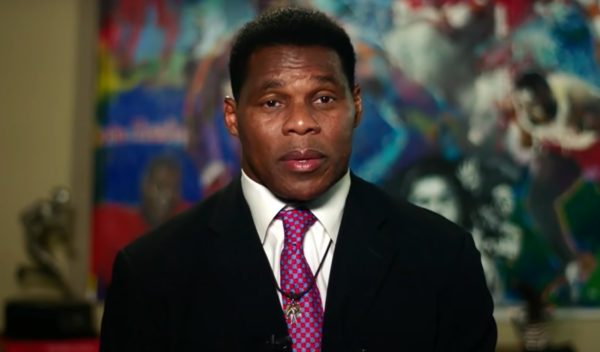
College Football Hall of Famer Herschel Walker, 58, spoke against a bill that purportedly would pave the way for reparations for descendants of slaves during a Feb. 17 hearing.
Walker, a supporter of former President Donald Trump, said during a House Judiciary Committee meeting Wednesday that “atonement” wouldn’t help Black people.
House Democrats have reintroduced a bill that would establish a federal commission tasked with studying the impacts of slavery bring redress to the economic, educational and health disparities that divide the nation along racial lines.
“The government must account for its ongoing role in perpetuating, supporting and upholding white supremacy,” said Rep. Cori Bush, during the Feb. 17 hearing regarding bill H.R. 40.
Walker, one of several dignitaries who spoke at the hearing, said reparations are a moot point in 2021 and that race relations are improving.
“My religion teaches togetherness. Reparations teaches separation,” he said in his testimony. “Slavery ended over 130 years ago. How can a father ask his son to do prison time for a crime he committed?”
The bill, sponsored by Rep. Sheila Jackson Lee, has been reintroduced for 30 years but has been unsuccessful.
It was first introduced by the late Rep. John Conyers in the late 1980s. A hearing was last held for the bill in 2019.
President Joe Biden has expressed his support for the study of reparations for descendants of slaves.
According to H.R. 40s text, the commission created by the bill, which has 162 co-sponsors, would “consider a national apology and proposal for reparations for the institution of slavery, its subsequent de jure and de facto racial and economic discrimination against African Americans, and the impact of these forces on living African Americans, to make recommendations to the Congress on appropriate remedies, and for other purposes.”
During the hearing, Walker questioned how Blackness would be measured if the bill were passed, and inquired about the economics of repayments to millions of Americans.
University of Connecticut professor Thomas Craemer, who has studied race and reparations for 15 years, estimates that the cost of slavery and loss of wealth through slavery amounts to $14.5 trillion dollars without adjusting for inflation. He believes the recent stimulus checks could provide a blueprint for how reparations could be distributed.
“[The] experience of trillions of dollars being sent to people’s homes, through the tax system might, you know, might be an example of how this could be done fairly easily,” Craemer said.
Rep. Jackson seemed optimistic about the legislation process. “I think if people begin to associate this legislation with what happened to the descendants of enslaved Africans as a human rights violation, the sordid past that violated the human rights of all of us who are descendants of enslaved Africans, I think that we can find common ground to pass this legislation,” she told Black Press of America.


