
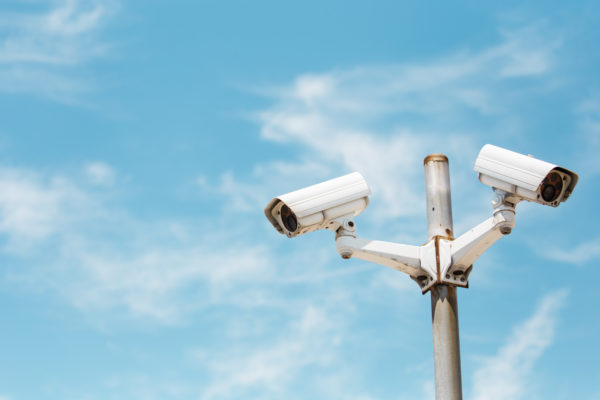
As part of its Project Green Light, the city of Detroit installed some 600 cameras equipped with facial recognition technology at schools, intersections, public parks and local businesses. (Photo: Sebastian Kopp/EyeEm for Getty Images)
Residents in Detroit, Michigan, are pushing back after a Georgetown University report detailing the city police department’s quiet use of controversial facial recognition software to make arrests.
The “America Under Watch” report, published in May, highlights real-time face surveillance software used by police agencies across the U.S. and has since sparked fierce debate over the technology infringing on privacy and free speech rights. Residents of the majority-Black Michigan city are more concerned about racial bias and point out that flawed facial recognition technology tends to misidentify people of color.
Police officers’ alleged capability to use the software to monitor residents in real time has become a major concern among folks in the community, civilian Detroit Police Commission member Willie Burton says.
“This should be the last place police use the technology, because it can’t identify one black man or woman to another,” Burton told The Guardian. “Every black man with a beard looks alike to it. Every black man with a hoodie looks alike. This is techno-racism.”
At a commission meeting on the issue held in July, tempers reached a fever pitch and Burton was forcefully grabbed from his seat and handcuffed after his “disruptive” objection to the city’s use of facial recognition cameras.
“If you throw me out of office, you are disenfranchising 100,000 voters in the 5th District, do not touch me,” Burton yelled as he was arrested, later ordering officers to “get your hands off me!”
“Don’t touch me!” he continued. “You don’t have permission to touch me.”
Burton was jailed briefly, and the charges against him were later dropped.
The growing use of facial recognition technology has raised questions over whether police are violating citizens’ privacy rights by quietly tracking their everyday moves. Clare Garvie, a contributing author on the Georgetown University report, estimates that nearly a fourth of the country’s 18,000 police agencies now use the controversial software.
She told The Guardian that such surveillance “betrays information about sensitive locations — who someone is as a person, whether they’re going to church, an HIV clinic. And the Supreme Court has said that we have a right to privacy even if we are in public.”
According to the outlet, Chicago has used similar technology to nab suspects, while New York Gov. Andrew Cuomo has tried implementing the program with little success. Over in California, the LAPD is reported to have a few street cameras that track the public in real time.
Detroit’s latest public surveillance effort, known as Project Green Light, saw the installation of nearly 600 high-def cameras at intersections, parks, schools, churches and local businesses across the city. Police use of facial recognition has since stoked fears of real-time surveillance — rumors the city’s leadership has struggled to put to bed.
“Let me be clear: there will be no facial recognition software used with live stream video by the (Detroit Police Department),” Mayor Mike Duggan said in a tweet last month. “That’s not what we’re doing, and that’s not ever what was intended.”
Rather than using a live stream to track and find suspects, the department pulls still images from private cameras then uses facial recognition to cross-reference the photos with mugshots from a police database and sources such as driver’s license photos and pictures taken from social media. Still, critics argue that this raises major concerns.
“Face recognition on live video is indeed considered the most invasive form of tracking,” Alvaro Bedoya, founding director of Georgetown Law Center on Privacy & Technology, told The Detroit Free Press in a recent interview. “But non-live video use of face recognition is still immensely problematic.”
In their report, Bedoya’s colleagues highlighted Detroit’s 2017 purchase of facial recognition software from the South Carolina-based DataWorks Plus in which they shelled out $1 million for a plan that does have “livestream video” abilities.
Still, the city has denied any plans to use that feature of the technology.
Detroit residents remain bothered by the facial recognition alone, and said it has only made them more distrustful of police. Locals were reportedly unaware that the city’s new Green Light cameras would be equipped with the technology, as were the property owners who installed them, according to the Georgetown report.
“There’s been no transparency and we won’t stand for it,” Burton told The Guardian. “We don’t want it here, and we are going to fight back because we deserve better.”
Detroit police didn’t return Atlanta Black Star’s request for comment.


