This month’s Bureau of Labor Statistics report came with both good and bad news: the U.S. is seeing the lowest unemployment in almost 50 years, yet the jobs situation for African-Americans remains considerably worse than that of any other racial group.
The bureau’s “employment situation” report, released Friday, showed that the national unemployment rate dropped to 3.6 percent in April, the lowest its been since November 1969. For African-Americans, however, the jobless rate was 6.7 percent, putting it 86 percent above the national average.

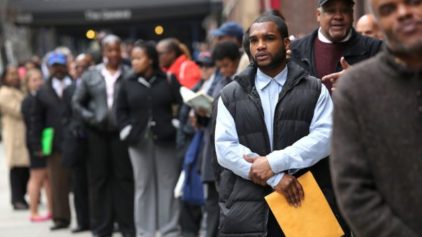
The Black unemployment rate is at a record-low 6.7 percent, but African-Americans still fare worse than other groups when it comes to joblessness. (PeopleImages/Getty Images)
Black folks fared even worse when compared to other groups. For instance, the unemployment rate for Blacks was a whopping 116 percent higher that of whites and 204 percent higher than for Asian Americans. Only one group had a worse jobless rate, and that was teenagers at 13 percent.
The rate of Black unemployment has moved up and down in the last year, but hasn’t seen any significant changes. What’s been more concerning is that Black folks continue to fare worse than almost any other group when it comes to joblessness, and people want to know why.
Financial news site 24/7 Wall St. explained that reasons for the growing unemployment gap are complex, but not unfamiliar.
“The reasons are not simple, and there is no single dominant one,” the outlet reported. “Among them is that black unemployment in large urban populations is often much higher than the national average for Black Americans,” coupled with the fact that a large chunk of the Black population is in prison.
“As prisoners move back into the general population, it is much harder for them to get jobs than other people,” the news site added. “Employers often are wary of hiring people with criminal records.”
Segregation also has negative impacts on employment, and tends to keep Black Americans from the best education and housing opportunities.
“People are not walking around, working together, going to school together, taking the same metro together, et cetera,” Camille Busette, a senior fellow at the Brookings Institution told 24/7 Wall St. last year. “So there isn’t a lot of familiarity. People tend to hire people like themselves, so when you get residential segregation, you tend to also get employment segregation.”