
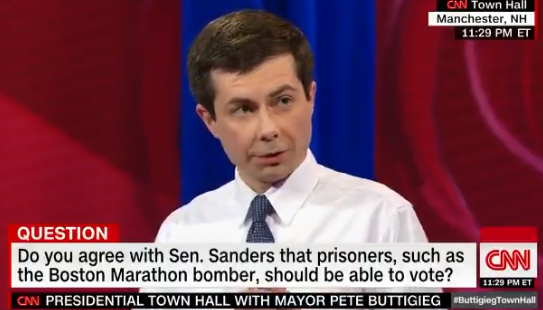
Mayor Pete Buttigieg stressed the importance of re-enfranchisement, saying felons should regain their right to vote once they’ve served their sentence. (CNN / video screenshot)
South Bend, Indiana, Mayor Pete Buttigieg ignited a debate among social media critics Monday when he said incarcerated felons should NOT be allowed to vote.
Buttigieg, who launched his bid for president earlier this month, made the remark during a CNN presidential town hall in Manchester, New Hampshire, where he and fellow Democratic hopefuls Sens. Kamala Harris and Bernie Sanders addressed issues such as immigration, LGBTQ rights and criminal justice reform.
When moderator Anderson Cooper asked Buttigieg if he was in favor of felons — including those convicted of violent crimes like terrorism, sexual assault and rape — being able to vote during their incarceration, Buttigieg said he opposed the idea.
“No, I don’t think so,” the mayor began, drawing raucous applause from the audience. A young Black woman seemed completely shocked by the stance.
“Part of the punishment when you’re convicted of a crime and incarcerated, is you lose certain rights. You lose your freedom,” he continued. “And I think during that period, it does not make sense to have an exception for the right to vote.”
The Indiana mayor, a 37-year-old former Naval commander who’s openly gay, supports re-enfranchisement, however, and said he believes felons should have their voting rights restored after they’ve served their time.
In most U.S. states, felons regain their right to vote upon release or after a period of probation/parole, according to the National Conference of State Legislatures. Other states, including Delaware and Iowa, suspend a felon’s voting rights indefinitely, depending on the crime, or require a governor’s pardon in order to have their full voting rights restored. Two states, Vermont and Maine, allow felons to vote while incarcerated regardless of their crime.
“When you are out [and] you’ve served your sentence, part of being restored to society is that you’re part of the political life of this nation again,” Buttigieg said Monday. “One of those things is the right to vote.”
Though rules on felon disenfranchisement vary from state to state, the presidential hopeful said it’d be best if all states supported re-enfranchisement and took aim at those who don’t.
“Frankly, I think the motivation for preventing that sort of re-enfranchisement, in some cases, have to do with one side of the aisle noticing that they politically benefit — and that’s got some racial layers to it,” he told host Anderson Cooper.
Buttigieg’s stance on the issue sent shock waves across the Internet, leaving many social media users split on the issue.
“You just dropped out of my top five,” one Twitter user wrote. “This is a terrible stance.”


