
Why Reading Some of the Most Disheartening Documents In Black History Is Good for Oprah

oprah winfrey

Oprah was the first guest on “The Goop Podcast.” (Photo by Jason LaVeris/FilmMagic)

Oprah Winfrey has never been shy about opening up about her past and she’s revealing that reflecting on it helps fuel her in times of a crisis — even if it’s relatives from centuries past.

Some of O’s most treasured keepsakes are documents from enslaved Black people and she says looking at them when she’s feeling rundown can be like a reset button for her.
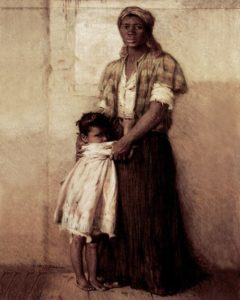
oprah winfrey

(Harry Roseland)

“I will speak their names out loud,” Winfrey says on actress Gwyneth Paltrow’s “The Goop Podcast” Friday, March 9. “I will speak their names out loud — Douglas, and Jenna, and Carrie, and Sarah and Anna — and their ages, and their prices, and remind myself of how far I have come. And no crisis seems that much of a crisis after you look at the names, the ages, the prices of people who were before you — who made this way possible.”

Also, an important piece to her is a 1906 piece of art by Harry Herman Roseland, “To the Highest Bidder,” which depicts an enslaved woman with her enslaved daughter clinging to her.

“When you come in my house, that’s the first thing you see and that is the grounding painting for me,” she said. “That woman, who I’ve named Anna and her daughter Sarah, I don’t even know their story, but I know their story.”

Independent journalism still matters.

We hope this story was worth your time. For over 14 years, Atlanta Black Star has stayed Black-owned and independently run. We didn't get here by waiting on ad budgets that were never built to prioritize us. Our readers did that.

Corporate support for Black media has always been thin. Outlets like ours get roughly 1% of the $170 billion spent on U.S. advertising each year, and that margin is shrinking further as advertisers walk back the DEI-linked commitments they made in 2020. That's the backdrop. It's not why we're asking.

The wider picture isn't any steadier. Newspaper ad revenue has fallen more than 80% since 2005, and local newsrooms are closing at a rate of roughly two a week nationwide. When outlets go under, it's rarely the ones built to center a Black perspective from the ground up that get to stick around.

We know a request for support isn't why you came here. But without readers choosing to fund this work directly, the depth of reporting we can do at home and abroad shrinks along with everyone else's. If you're not in a position to give, that doesn't change how much we value you as a reader.

If you are able to, a recurring contribution does more for us than a single one-time gift, because it lets us plan the next investigation instead of just the next invoice. It takes about 30 seconds, no long form, no account. Thank you for continuing to support independent journalism and freedom of the press.

Back to top