https://www.youtube.com/watch?v=x_2r5H-XJME
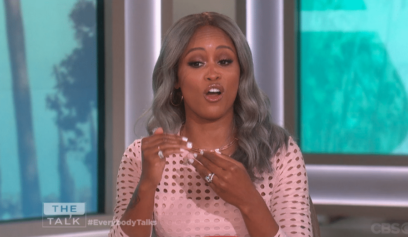
One thing singer Eve challenged herself to do this year was to embrace her beauty without makeup. She did just that Thursday, Jan. 11 alongside her “The Talk” co-hosts, who also bared their natural beauty (although Sheryl Underwood wore makeup on half of her face).
“Honestly, I’m still stressed out … I feel like I’m naked,” Eve admits,”But waiting for it was the hardest part and I’m glad that I’ve done it.
“It’s funny because I was thinking about this, and I’m like, ‘why have I been holding on to makeup for so long?'” she says. “It became a security blanket … I wore makeup for everything every time I was in public. And it became like putting on a bra in the morning. I wake up, I get dressed, I put on a bra, I put on some makeup.”
The rapper also explained she was afraid to show her flaws and of meeting people in public who would say she didn’t look like herself.
“I put on every type of mask and peel [I could],” Eve says of how she prepared to go in front of a live studio audience sans makeup. “I think it’ll definitely free up some time [in the morning].”
But Eve definitely didn’t need to worry about how viewers would respond, as they welcomed the change with open arms.
YOU LOOK MARVELOUS AS BILLY CRYSTAL SAID!
— Robin DiStiso (@rdistiso) January 12, 2018
I think Eve should go without makeup daily she is beautiful inside and out…# gogirl@TheTalkCBS
— Jenny Maynard (@JennyMaynard) January 11, 2018
Eve your Beautiful without makeup. Plz remember that God gave us beauty way before make-up. ❤😁
— Kathey T (@CrazyKathey) January 12, 2018
You all inspired me today. Especially Eve. She looks amazing with or without makeup. You all do.
— mary frances (@maryjanedoe73) January 11, 2018
I don’t know what she was so afraid of! She’s just has great skin, and looks just as beautiful without makeup!
— Holly Olson (@ImHollyMarie) January 12, 2018
And Eve isn’t the only star who dared to go bare.
Vocalist Alicia Keys centered her whole 2016 album promotion around natural beauty and hasn’t looked back since. Additionally, fellow singer Ciara recently shared photos captured by Seattle Seahawks QB hubby Russell Wilson sans makeup. Other stars who have flaunted their natural beauty include Gabrielle Union, Nia Long and Tracee Ellis Ross.