Chiwetel Ejiofor’s onscreen telling of a true story is beginning to come to life. His film adaptation of the 2009 autobiography, “The Boy Who Harnessed the Wind,” began production in Malawi this week. This is his directorial debut film, which does not currently have a title.
William Kamkwamba’s story describes how he used scrap material in his Kasungu, Malawi village of Wimbe to build a windmill. His ingenuity saved the community from drought and hunger.
“William’s story represents what has to be the future in countries like Malawi: developing countries, overflowing with beauty, and with potential [that] simply needs access to opportunity in order to be fully unleashed,” Ejiofor said in a statement to The Hollywood Reporter Thursday, Oct. 19. “William’s determination and inventiveness created something that not only meant the end of the ‘hungry season’ for his community, it also catapulted him into a future where all his potential could be realized.
More News on Chiwetel Ejiofor
‘Oprah’s Next Chapter’ Season 2, Episode 47: ‘Idris Elba, Chiwetel Ejiofor, Michael B Jordan’
Chiwetel Ejiofor Goes Django in New ’12 Years A Slave’ Trailer
Must-See: ‘Half of a Yellow Sun’ Trailer Starring Chiwetel Ejiofor, Thandie Newton
“I want this to be a film that allows people to see that Malawi, and the world, will be all the better for everything William and those like him are able to contribute when they have the opportunities they urgently need to carve out their own extraordinary destinies.”
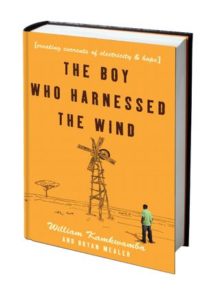
William Kamkwamba became famous in 2002 for saving his Malawi village.
(Scholastic)
Ejiofor will also star in the film as 13-year-old Kamkwamba’s father, Trywell. The film will see the innovative teen and his father go on an “emotional journey” after Kamkwamba, played by neophyte Maxwell Simba, is kicked out of his beloved school. He sneaks back to the library in order to learn how to build a windmill to save his village from starvation and uses parts of his father’s old bike to do so.
The film won’t be just a feel-good flick, either. The hope is to raise awareness for sustainability and power of education.
It seems to have some differences from Kamkwamba’s tale, however. According to his book website, the improvisatorial engineer dropped out of school after he was unable to pay tuition after the famine. And during a Jun 2007 TedTalk, it was noted that he was 14 or 15 when he built the windmill.