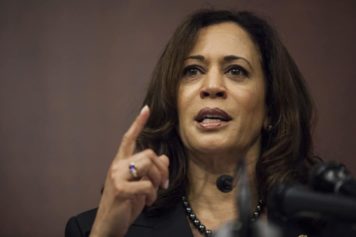
At the 2017 Ideas Conference, California Sen. Kamala Harris pointed out that drug addition isn’t just a “Black and brown” issue. (Photo by Zach Gibson/Getty Images)
California Sen. Kamala Harris isn’t here for the racialized double standard when it comes to discussions surrounding the crack epidemic of the ’80s and early ’90s and the opioid crisis of today.
During a talk at the Center for American Progress’ 2017 Ideas Conference Tuesday, May 16, Harris spoke about her time as a prosecutor for the Alameda County District Attorney’s office and compared it to her present job, according to Mic. Harris, who is the second Black woman to be elected to the U.S. Senate, also highlighted the fact that her career as a senator began at the height of the opioid epidemic.
“Folks, let me tell you: These crises have so much more in common than what separates them,” she told conference-goers.
The former prosecutor then pointed to a series of headlines that illustrated stark differences between the way people addicted to crack — who were often characterized as Black — were described, compared to how the media now discusses opioid users, who are largely painted as white. The language describing crack addicts was often vicious and/or demonizing, while opioid addicts were characterized with more compassion.
“As you can see, this is not a Black and brown issue,” Harris said. “This is not an urban and blue-state issue. It has always been an American issue.”
Though the senator stopped short of pointing the finger at anyone for the way the two groups were treated, according to Mic, Harris was sure to highlight the shortcomings of the U.S. war on drugs. Still, she warned of Attorney General Jeff Session’s recent plans to revamp the war by resurrecting old policies that dealt the harshest of sentences for drug offenders. Under his direction, federal prosecutors would be ordered to bring the most severe penalties against drug traffickers — whether they’re low-level offenders or not.
“As the Attorney General has consistently said, we are reviewing all Department of Justice policies to focus on keeping Americans safe and will be issuing further guidance and support to our prosecutors executing this priority — including an updated memorandum on charging for all criminal cases,” DOJ spokesman Ian Prior said earlier this month.
Harris argued that Sessions is working to revive the very policies that have proven to be counterproductive, ineffective and a “bad return on investment” for American taxpayers.
Yeshiva University legal scholar Ekow Yankah also has noted the double standard in the way we talk about and treat the opioid crisis vs. the crack epidemic.
“When addiction was a Black problem, there was no wave of national compassion,” Yankah said in a 2016 video essay published by PBS News Hour. “Instead, we were warned of ‘super predators,’ young, faceless Black men wearing bandanas and sagging jeans.”
For Harris, the goal is to form a sort of bipartisan coalition to fight Sessions and his agenda.
“To fight Jeff Sessions and his old-fashioned, discredited and dangerous approach to drugs, we must embrace what all regions have in common and build coalitions,” she said.