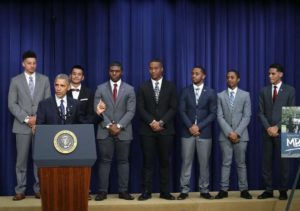
President Barack Obama speaks at the annual My Brother’s Keeper event at the White House, Dec. 14, 2016 in Washington, DC. Photo by Mark Wilson/Getty Images
As Obama prepares to end his time as president, he promised to remain invested in the “cradle to college to career” campaign launched under his administration two years ago known as My Brother’s Keeper.
“[This] is something that I’ll be invested in for the rest of my life,” the outgoing president said. “This is just the beginning. We are going to keep these efforts going to invest in our young people, to break down barriers that keep them from getting ahead.”
A one-of-a-kind mentoring program, My Brother’s Keeper was born out of a need to address the persistent opportunity and achievement gaps faced by Black American teens and young adults, specifically those who come from low-income neighborhoods. MBK has since been keeping Black youths on track by providing them with mentorships, summer jobs, college readiness and career training, as well as other opportunities designed to help remedy educational, economic and civic disparities.
According to the campaign’s 2-year progress report, nearly 250 communities across all 50 states, Washington D.C., and Puerto Rico have heeded the President’s call and implemented MBK programs in their neighborhoods. Moreover, the initiative has garnered over $1 billion in support, with more than $600 million given from the private sector, philanthropic grants and in-kind resources.
With that funding, the program has managed to make significant progress over the past two years, including a $20-million budget measure creating New York’s first statewide MBK-inspired mentoring program, and the “Second Chance Pell” campaign, aimed at enabling incarcerated Americans to receive Pell grants to finance their post-secondary education, according to the report.
The new reality of a Donald Trump presidency, however, poses the threat of dismantlement by his incoming administration, but President Obama isn’t concerned and encouraged MBK supporters on Wednesday to hold fast to the program’s values, even if they weren’t going to be kept or supported by the new president.
“Although it is important for us to poke and prod and push government at every level to make the investments that are necessary, we can’t wait for government to do it for us,” he said at the campaign’s 2016 summit in Washington, D.C. “We have to make sure that we are out there showing what works.”
Obama went on to assert that, with a little love and guidance, young Black men like the ones he helped mentor can reach their fullest potential and “achieve anything they can dream.”
Black youths in America face a number of obstacles and disadvantages that their white peers don’t experience to the same degree, if at all. According to a 2013 report by The Sentencing Project, a nonprofit prison reform group, 1 in 3 Black males will go to jail in their lifetime. This is in stark contrast to the rate for white males, which was 1 in 17 at the time.
“Racial minorities are more likely than white Americans to be arrested,” the report read. “Once arrested, they are more likely to be convicted and, once convicted, they are more likely to face stiff sentences.”
Although Obama’s initiative has good intentions, many have criticized MBK and accused the campaign of pathologizing “Black communities without paying proper attention to the history and broader social issues” that caused the very social and economic achievement gaps it’s working to fix,” The Guardian reported.
But President Obama on Wednesday noted that the disadvantages faced by young Black men and other minorities today are largely the consequence of many years of neglect on the part of the government.
“We shouldn’t expect that we’re going to solve these problems overnight,” he said. “But we’ve got proof about what happens when we give folks a little love and you act on that love.”
Wednesday’s MBK summit was the last for the president but not the last for his mentoring program’s legacy. The White House announced this week that the MBK Alliance, a private-sector counterpart to the White House initiative, would host the annual summit in 2017 and continue investing in communities that accepted the MBK challenge.
https://www.youtube.com/watch?v=Ja0wqcsw6SE