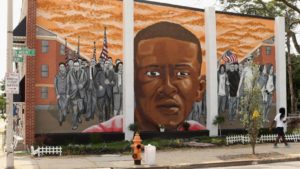
Mural of the late Freddie Gray in Baltimore, Maryland.
Baltimore. Chicago. Milwaukee. These are just a few of many U.S. cities grappling with police violence, civil unrest and high rates of poverty. Now, the Obama Administration is working to funnel nearly $10 million dollars into cities nationwide to help fund programs aimed at mitigating trauma felt by residents in those communities.
According to NBC News, The Substance Abuse and Mental Health Services Administration — a federal agency under the Department of Health and Human Services — plans to disburse a total of $9.7 million in grants to eight municipalities through its “Resiliency in Communities After Stress and Trauma” program, better known as ReCAST.
The city of Baltimore, plagued by nights of intense unrest last year following the tragic death of of Freddie Gray, recently received a $5 million grant through the program to promote the process of community healing. The funds will be distributed over a five-year period.
“Decades of poverty, neglect, racism, and widespread disparity have resulted in generations of Baltimoreans suffering from the effects of trauma in communities across our city,” said Dr. Leana Wen, Baltimore City Health Commissioner, in a statement. “We must recognize, treat and prevent trauma.”
“Through this grant, we’ll be able to directly engage and support our most valuable resources: our communities and our residents,” Wen continued. “Together, we will provide thousands of Baltimore residents with the tools and supports necessary to break systemic cycles of trauma and create a healthy, resilient, and well city.”
SAMHSA’s ReCAST program is designed to help high-risk youth and families in cities that have recently been impacted by violence and civil unrest, NBC News reports. The grants will be used to create programs in the West Baltimore neighborhoods of Upton/Druid Hills, Penn North and Sandtown-Winchester that offer yoga, mentoring and other youth development activities.
Per the Baltimore Sun, the activities will also focus on trauma-informed care, which takes into account how an individual’s life experiences impact their behavior and health.
Baltimore isn’t the only city reaping the “healing” benefits of the ReCAST program, however. Minneapolis, Chicago, Oakland, Milwaukee, Flint and St. Louis County, Missouri are just a few others that received grants as well.
Maryland Congressman Elijah Cummings, who represents Sandtown-Winchester — the neighborhood where Freddie Gray lived — said the newly funded outreach programs were desperately needed throughout communities in Baltimore.
“A lot of our children don’t even know what ‘normal’ is,” Cummings said of youth exposure to violence, loss and other trauma. “We can empower community-based organizations working to provide our most vulnerable — including our young people — with critical mental and behavioral health care.”
Baltimore organizations slated to benefit from the monies include Communities United, a citizen’s advocacy group; Seeds of Promise, a mentoring group for young Black boys; and the No Boundaries Coalition, which runs a youth leadership program called the Baltimore Youth Organizing Project, according to NBC News.
Cummings noted that when big money from the government is awarded to cities like Baltimore, Chicago and Flint, it’s a reason to celebrate. So, he’s thankful.
“There are people in Washington who don’t want our cities to get a dime,” he said.


