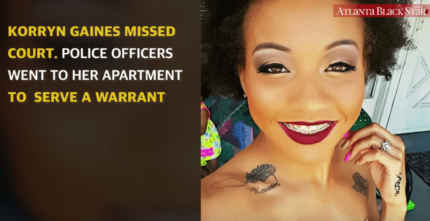
Korryn Gaines, 23, was killed by Baltimore County police following an hours-long standoff. Image courtesy of Instagram.
In the wake of numerous officer-involved shootings, social media has played a large role in the increased visibility of police encounters. The recent death of 23-year-old Korryn Gaines at the hands of Baltimore police sheds light on the complications posed by social media for police, as well as victims of police brutality.
Gaines was gunned down by officers Tuesday following an hours-long standoff in which the young mother barricaded herself inside her apartment with her 5-year-old child; she was also armed with a shotgun aimed straight at the authorities.
During the tense encounter, Gaines reportedly began live-streaming her ill-fated encounter with police for all the world to see. The footage was broadcast on her Facebook page, after which Baltimore County police requested that the popular social media site shut it down and deactivate her account. According to authorities, that was the first case in which they asked that an account be shut down in the middle of a lethal standoff.
“We did in fact reach out to social media authorities to deactivate her account, to take it offline, if you will,” Baltimore County police chief James Johnson said Tuesday. “Why? In order to preserve the integrity of the negotiation process with her and for the safety of our personnel [and] her child. Ms. Gaines was posting video of the operation as it unfolded. Followers were encouraging her not to comply with negotiators’ request that she surrender peacefully.”
Many can’t help but compare Gaines’ case to that of 32-year-old Philando Castile, the Minnesota man who was shot to death by police as he reached for his identification during a traffic stop. The bloody aftermath of the shooting was live streamed via Facebook by Castile’s girlfriend, who could be heard detailing what occurred before her boyfriend was killed by police.
Pulling out a cell phone to record police encounters is seemingly the new norm. Like Gaines, some resort to shooting live footage in an effort to protect themselves and preserve a record of what actually occurred during the incident. Body cameras also serve a similar purpose for police. Yet according to the Baltimore Sun, the officers involved in the deadly standoff with Gaines weren’t using them even as they worked to curtail the young woman’s ability to post live video.
“That law enforcement sought to stop a video feed during this incident is particularly concerning when they themselves were not wearing body cameras,” said Rowland Lee, a senior staff attorney with the ACLU’s Speech, Privacy and Technology Project. “As a result we only have law enforcement’s narrative of what occurred at the end of this standoff.”
Lee also warned that Facebook should be careful about how it chooses to comply with law enforcement and censor user content. The Baltimore Sun reports that Facebook confirmed the deactivation and subsequent reactivation of Gaines’ account, though it ultimately had to delete two videos posted on the young mother’s page because they violated the site’s terms of service.
A spokeswoman for the company couldn’t describe exactly was in the videos, but said it contained content that showed “credible threats of physical harm to individuals,” which is prohibited from the website.
“Here, this is a situation where police have told the public that this woman was a security risk and the aggressor, and visual evidence would only have served to confirm their account,” Lee said. “We should all be troubled … when Facebook is making ad hoc decisions about when to cooperate with law enforcement.”
Recent data provided by Facebook regarding law enforcement requests for information shows a steady uptick in police petitions. According to the Baltimore Sun, the site received over 19,200 requests for information from law enforcement between July and December of 2015 and provided some kind of data in more than 80 percent of those cases.
Still, Facebook’s compliance with police to shut down Gaines’ account when officers weren’t utilizing body cameras has many questioning the motive of authorities.
Can't rely on FB Live to show police violence for the same reason we can't rely on body cams: cops will turn it off. https://t.co/Fdoqicqz1Z
— anildash.com (@anildash) August 4, 2016
Potentially aiding a police cover up by censoring an individuals personal content = lawsuit & should bother EVERYONE https://t.co/V3od51z5IM
— The OTHER Sanaa (@SanaaMsemaji) August 3, 2016
Pay Attention FB is FBI book…
They are in collusion with the Police and Feds… #KorryGaines #SayHerName… https://t.co/3mwG64Lal6— RFT (@RaceForTheTimes) August 2, 2016
https://twitter.com/AndrayDomise/status/761196050040225792
They control the narrative, but in controlling the narrative they have to control social media … https://t.co/W8KOFYMiKx
— Ed Summers (@edsu) August 4, 2016