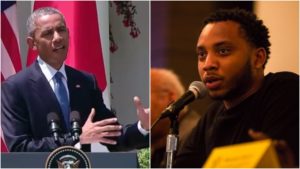
 The city of Baltimore erupted into chaos last April following the funeral of Freddie Gray, a 25-year-old African-American man who died of severe spinal injuries sustained while in the custody of Baltimore police officers.
Tensions had been building for days after Gray’s death, with multiple standoffs between protesters and local police.
President Obama angered many social justice advocates when he referred to protesters as “criminals and thugs who tore up” the city during a White House press conference the next day on April 28.
“When individuals get crowbars and start prying open doors to loot, they’re not protesting,” he said at the time. “They’re not making a statement. They’re stealing.”
Critics accused the president of employing the same racial coded language often used by politicians and members of the media.
Empowerment Temple AME Church pastor Jamal Bryant, who delivered Gray’s eulogy, called Obama’s statements and similar ones made by Baltimore Mayor Stephanie Rawlings-Blake acts of “Black-on-Black crime,” in an interview with Fox’s Megan Kelly.
“They have committed Black-on-Black crime by using that word against people who look just like them. Absolutely,” Bryant said, per Mediaite.
Baltimore activist Kwame Rose, who was arrested during the maelstrom, was another of the president’s strongest attackers. He told NPR Morning Edition‘s Steve Inkeep that Obama spoke prematurely, without taking into account the stories behind each of the individuals captured on camera that day.
“I was one of the people he called a thug and criminal,” he said. “I was out there.”
Rose also slammed the notion of separating the frustrated protesters into two different groups: peaceful demonstrators and violent looters.
“I was there first hand [to] experience watching people run into the stores. I didn’t interpret it as violence. I interpreted it as a survival skill, a survival tactic,” he added.
When asked whether the president has been supportive of the cause, Rose was blunt.
“No, I don’t think the president has done anything for Black people.”
Inkeep gave the president a chance to respond to Rose in an interview published to the public radio site Wednesday morning. Obama said opponents need only look at his administration’s efforts for criminal justice reform.
“What I would also say is that if somebody is looting, they’re looting. And the notion that they’re making a political statement is not always the case,” he said, echoing his previous sentiments about the matter.
“Because these are businesses that oftentimes are owned by African-Americans. You have situations in which suddenly — friends of mine in Baltimore — their mothers who are elderly have to now travel across town to get their medicines because the local drug store got torn up.”
The president said making excuses for the destructive protesters was a “mistake” and suggested alternative methods of affecting change in the justice system.
“There are ways of bringing about social change that are powerful and that have the ability to pull the country together and maintain the moral high ground. And where I understand the frustrations, but they’re counterproductive and tearing.”
As for charges that he has become a part of the corrupt system, Obama said he’s an easy target, as holder of the nation’s high office.
“I think that you can always find folks who are going to feel as if change hasn’t happened fast enough,” he said. “If there’s a problem out there, then I’m the ultimate public official that people know. And if it hasn’t gotten fixed within a couple weeks, people are gonna say, ‘Why didn’t you fix it?’ “

