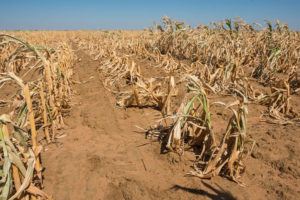
 South Africa will not declare a national disaster in response to a drought that has hurt agricultural production, the country’s deputy minister of agriculture, forestry and fisheries Bheki Cele told Reuters on Sunday.
“For some reason God has been kind and late rains did come, and we think the 6 million tons [of maize] we were looking to import — we have downgraded that to four,” he told Reuters in an interview on the sidelines of a conference in Dubai.
The country’s largest grain producer group Grain SA called on the government last week to declare a national disaster — a move that would release emergency relief funds from the National Treasury to eligible farmers.
Cele said out of South Africa’s nine provinces, seven had already declared a disaster but a nationwide declaration was not currently warranted.
“The only hope is that rains continue — if they do we might be out of the woods … We will not declare a national disaster” said Cele.
Cele argued support had already been granted to a lot of farmers and more was on the way.
Some complaints were raised by commercial farms as most of the assistance had gone to smaller scale farmers, he acknowledged.
“If you lose 36 cattle and go from that to zero that is one thing but if you have 4,000 cattle losing 36 well yes you have lost but we have to start with the small guy,” he said.
Cele also said the ministry was assessing the availability of white maize imports from Mexico to fill domestic food demand.
“I think the availability of white maize is the main issue. We will have money to import it, that is not a problem, but the problem is the availability,” he said.
In South Africa, white maize is made into what is known locally known as “pap”, the main source of calories for many households. The yellow variety is used almost exclusively as animal feed.
Outside southern Africa, white maize is grown in significant quantities only in Mexico and the United States.
“The Americans (U.S.) have also tried to avail themselves but the issue is understanding their crop stocks and how much of it is genetically modified,” said Cele, whose ministry also covers forestry and fisheries.
South Africa has stringent codes governing genetically modified crops.
The country has in the past sometimes mixed yellow and white maize for human consumption, but Cele said that if enough white maize could be obtained in the global market, this would not happen.
“At the present moment we could see an opportunity for avoiding that,” he said.
South Africa’s ports are fully prepared to receive maize imports, Cele added.
“The only snag we are working on now would be the actual distribution from the storage but arrival and storage are all sorted, just the actual movement between that storage and human consumption is what we are working on.”
Source: www.timeslive.co.za