Racial profiling is real, and Black motorists are not merely imagining the disparate treatment they receive.
Over the past year, the deaths of unarmed Black people during encounters with police in Ferguson, Baltimore, New York and elsewhere have brought a great deal of attention to the effects of racial bias on law enforcement behavior. Millions of African-Americans face the indignities of being stopped by police for no reason, which law enforcement often explain away and justify by pointing to high levels of violent crime in Back neighborhoods, a factor which has contributed to poor relations between the police and communities of color. As far too many dead Black bodies have resulted from these police stops, three high profile cases arising from minor traffic infractions including a missing front license plate, a failure to signal and a broken brake light, we must question why these people are being stopped in the first place.
A New York Times study of tens of thousands of traffic stops on Greensboro, North Carolina–a racially diverse city of 280,000 and the third largest in the state–found dramatic racial differences in police conduct. Further, the Times learned that these disparities were common across North Carolina, which collects the most data in the nation on traffic stops. Disparities were found in six other states that compile comprehensive traffic stop data.
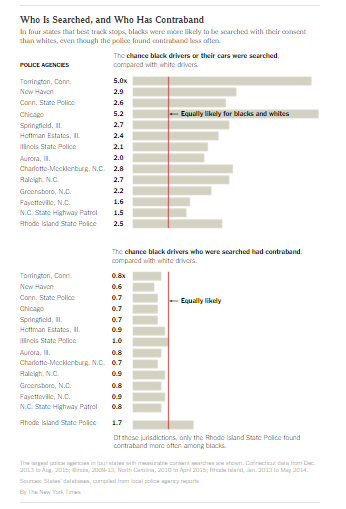 In Greensboro, which is 41 percent Black, police pulled over Black motorists for traffic violations far out of proportion to their share of the local population, the report found. In addition, officers searched Black drivers or their vehicles more than twice as often as white motorists, even though they found guns and drugs far more often among white motorists. Moreover, police were more likely to stop Black motorists for no apparent reason, and more likely to use physical force, even when not met with resistance.
Nationwide, as the New York Times points out, Blacks are arrested four times as often for the questionable offense of resisting, obstructing or delaying an officer. And while Blacks and whites use marijuana at nearly the same rate, Black residents in Greensboro are charged with possession of minor amounts of marijuana at five times the rate of white residents.
While law enforcement in North Carolina, not unlike their counterparts in New York, Chicago and elsewhere, justify their practices on the grounds that Blacks live in high-crime areas, criminal justice experts are questioning whether there are any benefits to such aggressive traffic enforcement, even noting there is no relationship between more traffic stops and lower crime rates.
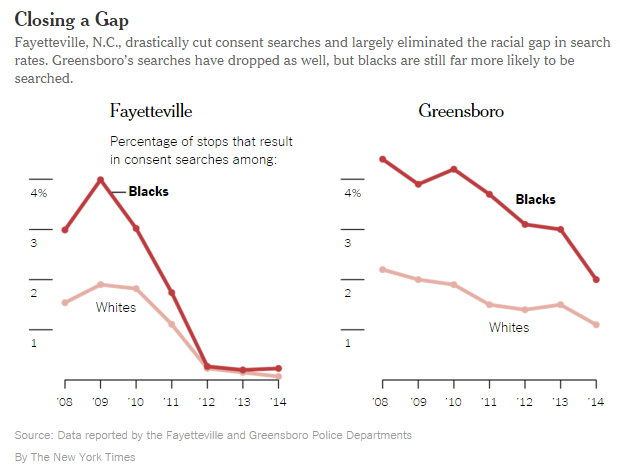 The issue of racial profiling and traffic stops emerged in the 1990s, after it was learned that New Jersey state troopers concentrated their efforts on stopping drivers of color in the hopes of catching drug couriers. Since that time, dozens of state law enforcement agencies and thousands of local police departments began collecting traffic stop data. In the states with the most extensive reporting requirements — Connecticut, Illinois, Maryland, Missouri, Nebraska, North Carolina and Rhode Island — police are more likely to pull over Black drivers than white ones. However, what happens once a stop is made is even more revealing. In four states that track consent searches, police were more likely to conduct such searches when the motorist was Black, even though white drivers were consistently found to possess drugs, guns or other contraband more often. The same was found in probable-cause searches in Illinois and North Carolina, the two states that carefully record them.
Two states–Rhode Island and Connecticut—have changed their practices in light of the racial disparities. Rhode Island overhauled its training and conducted fewer vehicle searches, while finding contraband more often. Further, Connecticut requires its officers to give every stopped driver a card explaining how to file a police complaint.
Meanwhile, California recently passed a law requiring police officers to record traffic and pedestrian stops.
For Greensboro, the issues concerning racial bias in policing reflect a troubled past, for a city that prides itself on a progressive legacy, while grappling with a troubled history of racism and police oppression. The first Southern city to pledge to integrate its public schools following Brown v. Board of Education was one of the last to actually follow through. Further, with the sit-in of four Black freshmen from North Carolina A&T State University at a whites-only Woolworth counter in 1960, Greensboro gave birth to a sit-in movement that would spread throughout the South. Further, this is the city where in 1969, the National Guard clamped down on Black student protesters at A&T, a center for Black Power organizing in the South, and James B. Dudley High School. One student was killed. A decade later, five protesters were murdered at an anti-Klan rally were there was no police protection.
Meanwhile, in 2009, 39 police officers of color accused the Greensboro police department of racial discrimination. The city spent nearly $1.3 million on the suit before settling for $500,000. Today, Greensboro is 48 percent white, yet 75 percent of its 684 police officers are white.