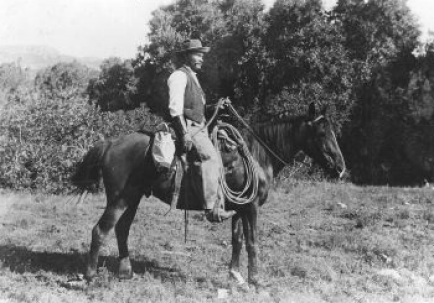
Photo of McJunkin, courtesy of Georgia and Bill Lockridge, former owners of the Crowfoot Ranch
George McJunkin, freed from slavery at 14, headed west when he was 17, to New Mexico, seeking open space to create a new life. He ended up making an archeological find that changed how we think about the origin of life in North America.
In fact, McJunkin, who became a cowboy while living in Dodge City, KS, found proof that human beings existed on earth long before anyone had ever thought, a stunning discovery at the time
It started back on Aug. 27, 1908, according to The Root. A flood devastated the town of Folsom, N.M., where 1,610 African Americans lived, many of them former enslaved people. McJunkin, who taught himself how to tell time, learned to read and build, was the ranch foreman, and once the storm passed, he searched for some broken fences.
What he also found was a huge gully created by the flood in an area called the Dead (or Wild) Horse Arroyo. In it was a dynamic find: bison bones far too big and buried far too deep to belong to any animal of that time.
McJunkin knew his discovery was historic and pleaded for friends to see his the “Bone Pit.” They would not come.
Seven months after his death, two fellow hobbyists Carl Schwacheim and Fred Howarth, visited the bone site McJunkin had often invited them to visit. When they did, they grasped the enormity of McJunkin’s discovery. It took four years, but finally the site was excavated by archaeologists from the Colorado Museum of Natural History.
The remains the team unearthed allowed them to identify Bison antiquus, which was about twice the size of modern American bison and extinct for some 10,000 years.
Moreover, in addition to the fossils was the discovery of the spear point embedded between the bison’s ribs, which experts deemed proof that humans had lived in North America much earlier than previously believed.
Historian Mary Germond said, according to The Root, “McJunkin had come upon the kill site of Stone Age hunters gone more than 100 centuries.”
The weapon of choice of the ancient people, historians determined, was a previously unknown spear called the Folsom point.
In the 1950s, through the use of the recently developed technique of carbon-14 testing, the spear points found at the site were dated as far back as 9000 B.C. Until then, human habitation of North America had been placed at 3,000 or 4,000 years ago, but the spear points pushed that date back an incredible 7,000 years.
According to The Root, Schwacheim and Howarth were acknowledged in the early literature about the Folsom findings; McJunkin was not. A half-century after McJunkin died, his role in archeological history unknown, a Paleo-Indian archaeologist at Eastern New Mexico University named George Agogino learned the history of the Folsom site and finally gave McJunkin the credit he was due for the discovery of the bones that shifted the timeline of human settlement in North America.


