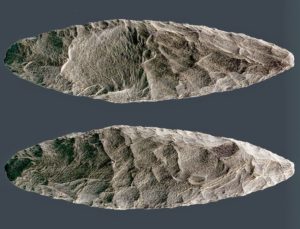
carbonized plant remains found in South Carolina
President Obama attempted to deliver a history lesson this week to Americans opposed to him latest immigration plan, saying that perhaps the only people who can legitimately be pissed off about illegal immigrants are Native Americans. But the president didn’t take the history back far enough, as researchers have found evidence that humans with Negroid features inhabited North America possibly as long as 50,000 years ago.
“If you look at the history of immigration in this country, each successive wave there have been periods where the folks who were already here have said, ‘Well I don’t want those folks,'” Obama said. “Even though the only people who have the right to say that are some Native Americans.”
“Part of what America is about is stitching together folks from different backgrounds and different faiths and different ethnicities,” he added. “That’s what makes us special and, look, let’s face it, sometimes that’s hard to do, but it’s worthwhile, it’s worth doing.”
While the “Clovis model” that archaeologists have adhered to for most of the 20th century held that people first arrived in the Americas from Asia about 13,000 years ago, more recent finds have upended that theory.
While stone tools and charcoal from the Pedra Furada sites in Brazil show evidence of human habitation as long ago as 50,000 years, there were radiocarbon tests conducted by University of South Carolina archaeologist Dr. Albert Goodyear in 2004 of carbonized plant remains and artifacts unearthed along the Savannah River in Allendale County, S.C., indicating that humans inhabited North America at least 50,000 years ago, long before the last ice age, according to the New York Times.
In addition, researchers have unearthed stone tools proving that humans reached what is now northeast Brazil as early as 22,000 years ago.
“If they’re right, and there’s a great possibility that they are, that will change everything we know about the settlement of the Americas,” said Walter Neves, an evolutionary anthropologist at the University of São Paulo whose own analysis of an 11,000-year-old skull in Brazil implies that some ancient Americans resembled aboriginal Australians more than they did Asians. His comments came from a profile in the Times.
But such history notwithstanding, the president still was eager to pierce the somewhat ludicrous idea that this land belongs exclusively to the United States, a nation in existence for just 238 years.
Not all immigrants are pleased with the Obama amnesty plan. As the impact of the plan spreads, thousands of Haitians who fled to the U.S. after the 2010 earthquake are disturbed to discover they aren’t covered because they arrived after the five-year cutoff.
Marleine Bastien, executive director of Haitian Women of Miami, said she is having to disappoint a steady stream of recent Haitian immigrants when she notifies them of the plan’s details.
“Do the right thing. Be inclusive and go big, Mr. President,” Bastien said to NPR. “Go big.”
Of the estimated 11 million undocumented immigrants currently living in the US, Obama’s new directive will protect about five million from the threat of deportation, and permit many to work legally. Among that number are approximately 3.7 million parents of US-born children.
Lina, who arrived in Miami by boat from Haiti in 2012, has an American born daughter who is nearly a year old. But Lina, who told NPR she didn’t want her whole name used, is not eligible for a deportation waiver or a work permit because she’s lived in the U.S. for less than five years.
“Is that what we want, a nation that deports millions of people and that separates family?” Bastien asked.


