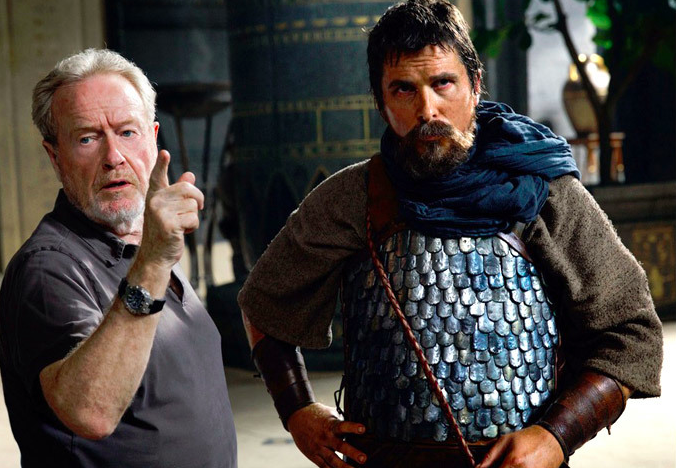
Ridley Scott and Christian Bale while filming “Exodus:Gods and Kings”
As the release date of Exodus: Gods and Kings draws near, director Ridley Scott has been receiving some backlash for casting white actors in the Egyptian movie. On Tuesday in an interview with Variety, he finally admitted that his one race casting decisions have been mostly about money.
“I can’t mount a film of this budget, where I have to rely on tax rebates in Spain, and say that my lead actor is Mohammad so-and-so from such-and-such,” he told the magazine. “I’m just not going to get it financed. So the question doesn’t even come up.”
The director was trying to shed light on the fact that Christian Bale and Sigourney Weaver, his lead actors, carry enough weight in the industry to entice backers to buy into the film, but the way in which he proves his point ended up shedding more light on the racial bias in Hollywood than anything else.
A recent study by the Bunche Center for African American Studies at UCLA found that white actors possessed nearly 90 percent of the lead roles in the 172 theatrical films released in 2011.
This movie about the story of Moses is not the first to present such huge disparities. Earlier this year, the public was outraged when Rooney Mars was cast as Tiger Lily, who is originally written as a Native American, in the upcoming Peter Pan film Pan. The casting decision led to an online petition with over 7,000 signatures asking Warner Bros. to “stop casting white actors to play characters originally written as people of color!” and the hashtag “#NotYourTigerLily” trending on Twitter, according to Georgetown Law Journal of Modern Critical Race Perspectives.
A 2006 study of Hollywood breakdowns from June 1st to August 31st of that year showed that 0.5 percent to 8.1 percent of roles were available for actors of color, compared to 69 percent of roles that were “reserved” for white actors and only 8.5 percent of roles did not have a race specification.
Separate from Scott, directors like Woody Allen have spoken out on the matter, claiming that it is talent, not race that causes them to cast their movies a certain way.
“You don’t hire people based on race,”Allen said via The New York Observer. “You hire people based on who is correct for the part. The implication is that I’m deliberately not hiring black actors, which is stupid. I cast only what’s right for the part. Race, friendship, means nothing to me except who is right for the part.”
While directors’ reasonings may vary, the numbers don’t lie and it is very clear that the racial gap in Hollywood is still alive and very well.