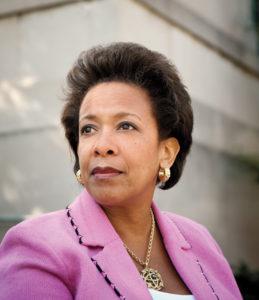
 President Obama, a figure who makes history virtually every time he steps out of bed in the morning, is about to do something historic once again, as he has announced he is replacing the first African-American Attorney General, Eric Holder, with the first African-American female Attorney General, Loretta Lynch.
In choosing Lynch, 55, Obama is offering a gift to every critic in the Black community who has castigated him for the scarcity of Black women in his cabinet’s inner circle. But while Holder was a close Obama confidant, the president doesn’t appear to have any close personal ties to Lynch—a fact that’s being hailed in the mainstream media as a major plus for a president who has been criticized by Washington insiders for not reaching outside his circle enough. In Washington, you get bonus points for hiring people you don’t know.
Holder was lauded in the Black community during his tenure for his bold and brash commitment to changing the justice system to be fairer and more equitable for African Americans and his desire to hold law enforcement and government accountable for too frequent abuse of African Americans.
But though it’s not clear whether Lynch will be as strong an advocate for African Americans, she has not been afraid to talk about racial bias she has personally encountered.
When she was asked in 2012 by a journal at Harvard Law School, from which she graduated in 1984, whether she had experienced racial bias in her career, Lynch said, “You mean when I was a young associate when I went to take a deposition and everyone assumed I was the court reporter. Or when I interviewed at a law firm and the receptionist looked at me and said: ‘You can’t be Loretta Lynch. She goes to Harvard.’ I think everyone has those stories.”
“Most African-Americans are very cognizant of assimilating into mainstream culture, but you’re also very aware of and very comfortable with your own culture,” she said. “To me, that’s an advantage. I think it makes you flexible; it makes you see things from more than one perspective. I look at people who have only one experience, and I think that’s really unfortunate. That’s where those comments come from. In their worldview, this is how they see black people. I learned a long time ago, I can’t really change your worldview. You can get to know me, you can spend time with me, and if your worldview changes as a result of that, fine. But it’s really not my job to try to change it.”
Lynch has shown that she has the courage to go after the New York Police Department and public officials when they step over into criminal behavior. One of her most prominent cases was the successful prosecution of members of the NYPD in the infamous Abner Louima case in 1997. Louima, 30, a Haitian immigrant, was beaten and sodomized with a broom handle by police officers in Brooklyn, who caused extensive internal damage. The case was such a racial tinderbox in the city that it prompted widespread protests and angry marches led by Rev. Al Sharpton and other activists.
Discussing the Louima case, Lynch told the Harvard Law School bulletin, “It was a very tense atmosphere. It was extremely racially and politically charged at the time. My way of dealing with high-profile cases like that is to completely separate from the press. What you have to do is insulate yourself.”
Lynch said the Louima case helped her understand why she did prosecutorial work.
“There were people who, until I worked on the Louima case, thought, Why do you do this? To me, I do it because I think everyone deserves protection,” she said. “Frankly, it shouldn’t be an easy thing to stand up and say this person by their actions has forfeited their right to walk among free people.”
Lynch is considered low-key and relatively unassuming, which is quite a statement in New York, a city used to federal prosecutors with big egos and a thirst for the spotlight—after all, former New York Mayor Rudy Giuliani rose to prominence as a crusading federal prosecutor.
Overseeing federal prosecutions in the Eastern District of New York, which includes Brooklyn, Queens, Staten Island and Long Island, Lynch leads an office that has become renowned for its work on organized crime, terrorism and public corruption.
According to the Times, her office is noteworthy for winning a rare death-penalty conviction for Ronell Wilson, who killed a police officer.
Gerald L. Shargel, a prominent defense lawyer, told the Times that Lynch was remarkably approachable.
“Any time I had an issue with a case and thought it appropriate to knock on her door, she was welcoming and gave, as U.S. attorney, gave the impression — and I think it’s a true impression — that she is fairly considering issues that you’re putting before her,” Shargel said. “There’s no self-aggrandizement.”
New York Senator Charles E. Schumer, who twice recommended Lynch to the White House as a United States attorney, released a statement calling her “a consummate professional.”
She “has a first-rate legal mind and is committed in her bones to the equal application of justice for all people,” the statement said.
The president is scheduled to appear with Lynch and Holder in an official announcement at the White House this afternoon.
Democrats may try to push for her confirmation next week during a lame-duck congressional session while they still control the Senate. But Senator Mitch McConnell, the Republican leader, said the nomination “should be considered in the new Congress, through regular order.”
Lynch for six years was an associate at the New York law firm Cahill Gordon & Reindel before becoming a federal prosecutor.