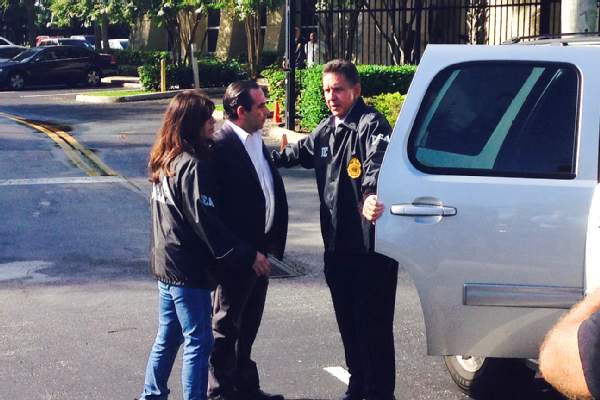
Anthony Bosch (center) turned himself in to DEA agents Tuesday.
Before sunrise Tuesday, Drug Enforcement Administration agents arrested several men involved with the now-defunct Biogenesis lab, an anti-aging/wellness business that was at the heart of a Major League Baseball performance-enhancing drugs scandal last year. Around the same time, the company’s founder, Anthony Bosch, and his attorney drove to a DEA office in Florida to surrender.
According to Special Agent in Charge Mark R. Trouville, Bosch was one of 10 people arrested Tuesday as part of a two-year Operation Strikeout investigation. U.S. Attorney Wilfredo Ferrer said at a news conference Tuesday that seven arrests were related to Biogenesis, and three were arrested as part of a separate indictment regarding the party drug Molly.
Federal sources said Bosch, 50, had reached a deal to plead guilty to conspiracy to distribute anabolic steroids between October 2008 and December 2012. He was led in a DEA vehicle to the U.S. District Courthouse in Miami after being processed in Fort Lauderdale. He faces up to a maximum 10 years in prison.
Among those arrested Tuesday was Yuri Sucart, the cousin of Alex Rodriguez, the baseball player who was suspended for an entire season for using PEDs. Federal agents described Sucart as one of Bosch’s recruiters. Sucart, 52, was banned from the New York Yankees clubhouse, charter flights, bus and other team-related activities by Major League Baseball in 2009 after Rodriguez admitted he used steroids while with Texas from 2000 to 2003, saying Sucart obtained and injected the drugs for him.
Carlos Acevedo (Bosch’s business partner), Jorge (Oggi) Velasquez, Juan Nunez, Christopher Engroba and former University of Miami pitching coach Lazer Collazo also were arrested along with Bosch.
Sources told ESPN’s Outside the Lines that MLB players and other pro athletes are not the focus of the federal investigation; rather, authorities focused solely on potential illegal activities involving Bosch and other associates.
Trouville, the special agent in charge of the case, said Bosch and his associates distributed performance-enhancing drugs to minors as well as professionals. Trouville said Bosch isn’t a doctor; “he’s a drug dealer.”
Bosch, a self-described biochemist, has been at the head of the largest performance-enhancing drug scandal in American sports history. To date, nearly 20 professional players connected to his clinic have been suspended by Major League Baseball after either testing positive or having their doping regimens uncovered in clinic records.
The aggressive, lengthy MLB investigation ended in a record number of suspensions, but at times proved tumultuous and costly. Baseball officials threw tens of thousands of dollars at potential witnesses in seeking to nail their case, at one point paying an ex-convict $150,000 for clinic documents — some of which a state health official said it should have known were stolen. Baseball’s Department of Investigations was recently overhauled in the wake of the Biogenesis investigation.