
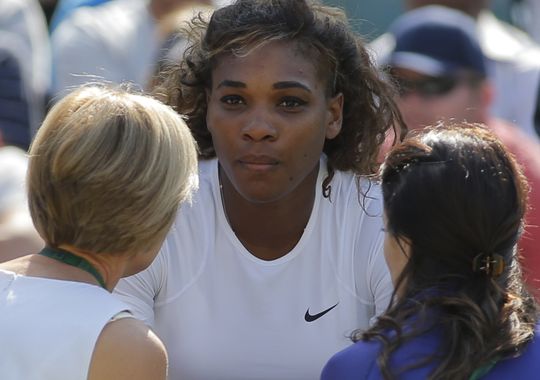
In a bizarre scene at Wimbledon, Serena Williams appeared disoriented in a first-round doubles match with sister Venus and was forced to retire after three games Tuesday.
The latest report from the referee’s office is that Williams is suffering from a “viral illness.”
Williams, who lost her third-round singles match Saturday to Alize Cornet of France, looked unsteady in the warm-up against opponents Kristina Barrois and Stefanie Voegele.
A doctor was called to the court, and Williams appeared to be in tears as she sat in the changeover chair. She buried her hands in her face and consulted with the doctor for 10 minutes before taking the court to play.
The BBC showed Williams leaving the grounds with her coach, Patrick Mouratoglou, who, in a text message, had said he had not seen Williams in two days.
Serving in the third game, Williams could at times barely grip or catch the tennis ball. All four of her serves were double faults. None even registered on the radar gun.
After a visit from the umpire, Kader Nouni, and consulting with Venus, the eighth-seeded sisters retired trailing 0-3.
Later, their half sister, Isha Price, said her 32-year-old sister had been “sad” and “emotional” since her loss three days ago to Cornet and hadn’t been eating much, but not more than normal after a tough loss.
Sasha Bajin, Serena Williams’ longtime hitting partner, declined to comment.
Price said Williams did not appear ill before the match, and she wasn’t aware of any medication she might be taking. Price said the five-time Wimbledon winner would not have taken the court if she were not well.
“She seemed emotional, sad, you know what I mean?” said Price, who declined to speculate on whether her sister’s state of mind had anything to do with Mouratoglou. “But before the match she was fine.”
ESPN analyst Pam Shriver, who was on the court, said it was one of the stranger things she had seen.
“You can have reasons not to feel right on the court but nothing that would make you not be able to hold the ball in your hand or catch the ball after a bounce or throw the ball up,” Shriver said. “You might hit four double faults in a row, but you’d make contact.”
Like many, Shriver said she wondered: “Is this a drama? Is this an act? If you’re not well, you need to get help.”


