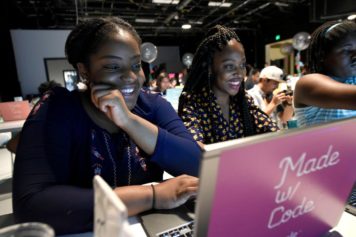
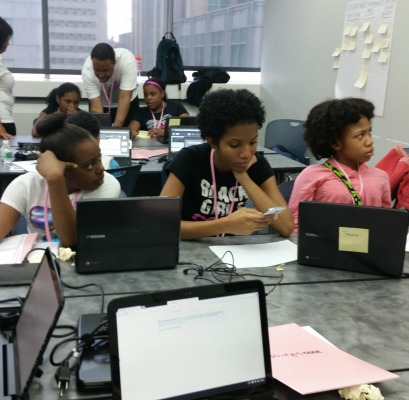
 Over 60 participants, 17 teams and two days of marathon computer programing — and they’re all girls of color under the age of 18.
This past weekend, Black Girls CODE, a nonprofit that teaches coding to girls from underserved communities, hosted its first ever hackathon.
“One of the biggest obstacles to Black girls getting into tech is lack of exposure,” said biotechnologist and engineer Kimberly Bryant, who founded Black Girls CODE in 2011. “We don’t see many role models for our girls to emulate. We see mostly white males at the top of the STEM fields.”
In fact, Black women are only 2 percent of the United States’ science and engineering workforce, while white men comprise 51 percent, according to the National Science Foundation. Google (GOOG) brought tech’s diversity issues into the spotlight last week, when it reported that just 30 percent of its employees are women and 2 percent are Black.
Black Girls CODE aims to change that by sponsoring tech events like its hackathon.
Hosted by the New York University Polytechnic Institute in Brooklyn, N.Y., the code fest is part of a series of three Black Girls Code hackathons taking place across the United States. The others will bring young programmers to hackathons in Oakland, Calif., and New Orleans.
“It’s no secret that there’s a diversity problem in tech,” said Alexis Ohanian, co-founder of social-networking site Reddit, who served on the judges’ panel for the coding competition. “When we get more people who are thinking about themselves as technologists, who are starting to learn this incredibly valuable skill, we’re going to benefit from so many other ideas that we never would have gotten before.”
Ohanian was also the anchor sponsor of a Crowdtilt campaign that raised over $12,000 for the Brooklyn hackathon.
So far, Black Girls CODE has served about 3,000 girls, many on scholarship, in six different cities to date.
Read the full story at money.cnn.com