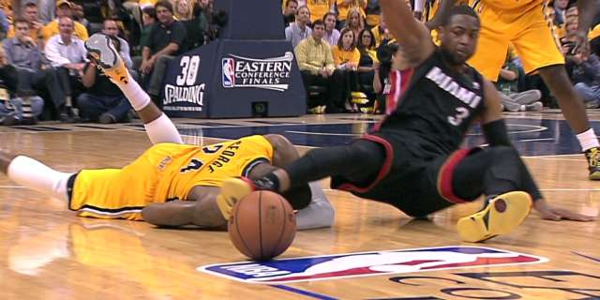
Paul George, the Indiana Pacers all-star forward, suffered a concussion Tuesday when he was accidentally knocked in the head by the Miami Heat’s Dwyane Wade, and his status for Saturday’s Game 3 of the Eastern Conference finals is in question.
The two were battling for a loose ball when they collided. George remained in the game for the duration of the Pacers’ 87-83 loss, but afterward he told reporters that he had blacked out and then had blurred vision in the contest’s final four or five minutes.
In a statement, the Pacers said George initially “exhibited no symptoms of a concussion” after the game, and “in response to questions from the Pacers’ medical staff, he denied dizziness, nausea and issues with his vision. He was also active and aware of his surroundings. As a result, the Indiana medical staff did not suspect a concussion.”
But when George later said he “blacked out” on the play, the team “conducted the NBA-mandated concussion assessment, which did not reveal any active symptoms of concussion.”
George, though, had follow-up tests Wednesday morning, at which point he was diagnosed by the Pacers’ consulting neurologist with a concussion because he said he had briefly lost consciousness during the game.
“The Indiana Pacers medical team followed the NBA concussion protocol and there was no indication of concussion during the game,” Dr. Jeffrey Kutcher, the director of the NBA concussion program, said in a statement. “This case illustrates that concussion evaluation is an ongoing process and manifestations of the injury may not always present immediately.”
Under the NBA’s return-to-participation protocol for concussions, players must go through “several steps of increasing exertion — from a stationary bike, to jogging, to agility work, to noncontact team drills. With each step, a player must be symptom-free to move to the next step.”
The final decision on whether he can return is made by the player’s team physician in conjunction with Kutcher.


