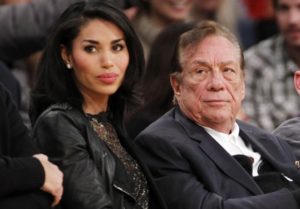
Stiviano and Sterling at Clippers game before scandal
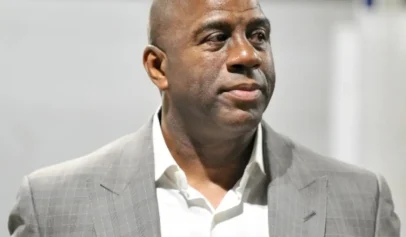
When Los Angeles Clippers owner Donald Sterling got a chance to apologize for his racist remarks that set off a national explosion and caused him to be banned from the league, he could barely get out the apology before he started insulting everyone involved, including NBA great Magic Johnson and African-Americans in general.
The remarks were so offensive that NBA Commissioner Adam Silver issued another apology to Johnson.
After saying he had “made a terrible mistake,” Sterling went after Magic, who was dragged into the scandal when Sterling’s female acquaintance, V. Stiviano, posted a picture of herself with Johnson on Instagram, inspiring Sterling’s wrath.
“Big Magic Johnson, what has he done?” Sterling asked of CNN host Anderson Cooper. “He’s got AIDS.”
When Cooper interrupted, pointing out that Johnson was diagnosed with HIV, not AIDS, Sterling went on, “What kind of a guy has sex with every girl, then he catches HIV? Is that someone we want to respect and tell our kids about? I think he should be ashamed of himself. I think he should go into the background. What does he do for the Black people?”
As most of the free world likely knows by now, Sterling received a lifetime ban from the NBA and a $2.5 million fine from Silver after audio recordings of his racist comments were released by TMZ and Deadspin. The recordings reveal Sterling telling Stiviano not to bring Black people to games or share photos of herself with Black people on social media.
Sterling implied that Johnson had two phone conversations with him and tried to trick him into remaining quiet after the scandal broke, perhaps as a way of moving in to buy the team.
When Cooper asked Sterling if he had offered an apology to the NBA legend, Sterling questioned Johnson’s status as a role model.
“Well, if I said anything wrong, I’m sorry,” Sterling responded. “He’s a good person. What am I going to say? Has he done everything he can do to help minorities? I don’t think so. But I’ll say it, he’s great. But I just don’t think he’s a good example for the children of Los Angeles. That he would go and do what he did, and then get AIDS.”
Sterling then went after the entire Black community, saying, “Some of the African-Americans—maybe I’ll get in trouble again—they don’t want to help anybody.”
He went on to contrast African Americans with Jews, whom he said are extremely willing to help each other, even establishing a way to lend money to other Jews.
It’s hard to believe that Sterling isn’t aware of the enormous amount of work Johnson has done over the years trying to bring viable businesses and jobs into the Black community—perhaps more than any other entrepreneur in America, in or out of the sports world.
Recently, Johnson teamed up with Canyon Capital Realty Advisors, a Century City investment fund, to develop properties in urban neighborhoods, targeting $8 billion for development and revitalization in major U.S. metropolitan areas through Canyon-Johnson Urban Funds, managers told the Los Angeles Times.
In addition, Johnson—who was part of the group that purchased the Los Angeles Dodgers—through the Magic Johnson Foundation has granted about $20 million to organizations that work on HIV-related issues, providing scholarships and technology to community centers, among other things.
In a statement, Silver apologized to Johnson since “he continues to be dragged into this situation and be degraded by such a malicious and personal attack. … The NBA Board of Governors is continuing with its process to remove Mr. Sterling as expeditiously as possible.”
In the CNN interview, Sterling claimed he “was baited” by Stiviano into making racist remarks.
“I mean, that’s not the way I talk. I don’t talk about people for one thing, ever. I talk about ideas and other things. I don’t talk about people,” he said.
While Sterling said he hoped that the 29 other owners, whom he called his friends, might not vote for a sale, he did not seem interested in a prolonged legal battle.
“But if you fight with my partners, what at the end of the road, what do I benefit, especially at my age? If they fight with me and they spend millions and I spend millions, let’s say I win or they win, I just don’t know if that’s important,” said Sterling.
From New York, where she was about to appear on NBC’s “Today” show Tuesday, Sterling’s estranged wife Shelly Sterling said, “These are the ravings of a sick, delusional man.”
Sterling said he didn’t believe the reports that players, fans and sponsors now hated him, blaming it all on the media.
“The media hates,” he said. “The media — it’s all the media pushing it.”
Cooper asked, “You really believe that it’s just the media?”
“I believe it 100 percent,” Sterling said.
“People call me by the thousands and give me support,” said Sterling, who has made an estimated $1.9 billion in the apartment rental business.
Speaking of Stiviano, Sterling got emotional, saying she was a “street person” who helped raise a family of 15 and whom he admired for that. But he said he was confused about why she had recorded their argument about Johnson and Black people.
“I mean … an 80-year-old man is kind of foolish,” he said. “And I’m kind of foolish. I thought she liked me and really cared for me. I guess being 50 years, 51 years over — older than her, I was deluding myself.”