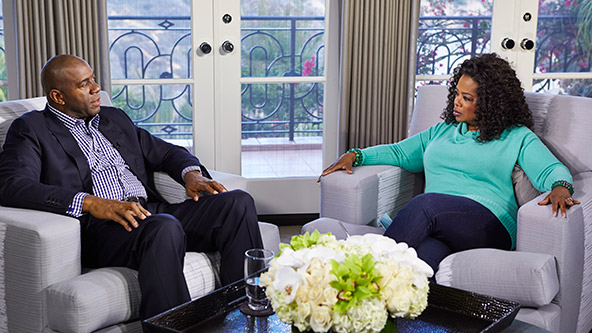
The Los Angeles Clippers, bound to be for sale on the open market once the NBA owners officially vote out disgraced team owner Donald Sterling, have become a draw for celebrities with significant resources. Once the worst franchise in the league, most everyone wants in on it now.
Start with Magic Johnson, the Lakers great who has become a business mogul. He seems a logical fit: He has deep NBA ties, a viable group of business partners and a record of success. He surely would appear to be the front-runner.
But many others with the financial means to bid on a team valued at about $550 million last year are reportedly interested, too.
The list includes media proprietor Oprah Winfrey, whose partners would include music mogul David Geffen and Oracle CEO Larry Ellison (who bankrolled last year’s America’s Cup-winning effort).
“Oprah is not interested in running the team,” Geffen told ESPN. “The team deserves a better group of owners who want to win. Larry would sooner die than fail. I would sooner die than fail. We’ve talked about this for a long time. Between the three of us, we have a good shot.”
Then there is boxer Floyd Mayweather Jr. and his group. Mayweather defends his title Saturday night in Las Vegas and will earn about $32 million. “Do we want to buy the Clippers? Yes, we do,” he said this week. “We’re very, very interested in buying the Clippers.”
Former boxing champion and current promoter, Oscar De La Hoya, is reported to have an interest in purchasing the team. So does Diddy, the rap producer, actor Frankie Muniz of “Malcolm in the Middle” fame. Rapper/producer Dr. Dre’s name has been mentioned, as well as rapper/producer Rick Ross.
Why such interest in a franchise that has won nothing? Because it is in Los Angeles, the place of stars. It was purchased by Sterling in 1981 for $17 million and, despite no success of note, grew exponentially in value over the years. It shares the Staples Center in downtown Los Angeles with the Lakers, which is a profit source with parking, ticket sales and concessions. The team is young and on the rise. The NBA has billion-dollar television contracts with TNT, ESPN, ABC and NBA-TV.
All of this is speculation, of course. Sterling has to be forced out and then has to not put up a legal fight to retain the franchise, which could drag on for years.


