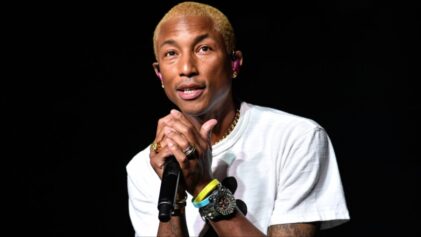
Pharrell Williams wasn’t holding back when he sat down for an interview with GQ Magazine and dished all his true feelings about the negative backlash he received for his “G I R L” album cover.
Pharrell is no stranger to expressing himself freely and honestly, and this interview was no exception.
Responding to the backlash he received about not featuring a Black woman on his album cover, Pharrell presented another message – Black is more than a color, it’s a spirit.
First, he reminded GQ’s Zach Baron that there was indeed a Black woman on the album. She simply had light skin.
Later in the interview, however, he explained that being Black is about so much more than a skin color.
“This is the new Black,” he said after questioning why so many Black people are interested in tearing each other down. “Oprah Winfrey: That’s the new Black. She’s a Black billionaire. President Obama: He is a Black American president…That’s the new Black. LeBron James: the first Black man ever shot on a Vogue cover, a Black man. Me: a guy that’s written a song at 40! Nominated for an Oscar, four Grammy awards – at 40! That’s the new Black!”
He then added, “Black is a spirit, and it is ubiquitous.”
The award-winning producer also believes that insecurity caused some Black women to be upset with his album cover.
“There were a lot of Black women that were really angry at some of those girls, but some of those girls are the ones that instantly get mad when they don’t see somebody that’s dark,” he said. “And it’s like: ‘Yo, you don’t need nobody to represent you. You represent you. You represent the best version of who you could be. You go out there and change the world.’ Because I’m Black, and I wouldn’t trade my skin color for nothing. But I don’t need to keep wearing a badge that tells you that I’m Black every time I do something!”
 After pointing out that his mother is Black and she runs his company and that his wife is Black, Pharrell dove deeper into the real issue surrounding the album cover controversy – people who are assigning levels to “Blackness.”
The Black woman on the cover didn’t receive recognition as being Black simply because she was of a lighter complexion.
“So why are we still having this conversation?” he asked. “Because look:” Lenny Kravitz is biracial, but to me and everybody else I know, he’s known as one of the biggest Black rock stars of all time. Our president: He’s biracial! Mom was white, daddy was Black, and he is Black. So what do you want me to do, go picket in front of the White House that he’s not Black enough?”
According to Pharrell, instead of trying to “point around and ask for that kind of sympathy,” Black people should “get together ourselves and support ourselves.”
“It doesn’t make sense to me,” he added. “That kind of divisiveness is not necessary at a time when we’re supposed to be unifying.”