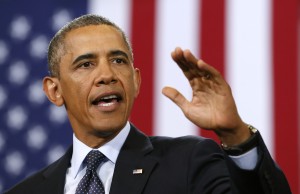
 As part of his continuing campaign to address income inequality in the U.S., President Obama this week will sign an executive order that will force American businesses to pay overtime to millions of professional workers who previously were denied overtime, potentially shifting billions of dollars from corporate coffers to the pockets of everyday American.
The move is sure to be fiercely opposed by business lobbying groups, who are already claiming that the president’s move will result in fewer jobs as businesses respond by doing less hiring. But many labor experts are applauding the move, which they see as boost for executive and professional workers who are increasingly being asked to work longer hours without additional pay.
The Obama administration also released the latest numbers on the Affordable Care Act, showing that a total of about 4.2 million people have signed up for health care insurance through exchanges, which is still far short of the Obama administration’s goal of 7 million. Republicans and conservative media will be sure to jump on the shortfall as a sign that Obamacare is an enormous disaster—though the White House expects to see another surge in enrollment number over the next three weeks as the March 31 deadline approaches for people to sign up this year and avoid a tax penalty.
In an election year, Republicans are looking for any way to use the Obamacare rollout to their advantage. Even though polls show a solid majority of Americans don’t want to see it repealed, Republicans will want to portray it as a massive failure.
According to the Department of Health and Human Services (HHS), more than 940,000 people signed up in February, bringing the total to 4.2 million people signed up since registration opened five months ago. Of that total, 1.6 million used state-run exchanges while the other 2.6 million used the federally run one. In addition, more than half are female, and 83 percent of those enrolled qualified for some form of financial assistance.
As for the executive order on overtime, it will direct the Labor Department to change its rules to require overtime pay for several million additional fast-food managers, loan officers, computer technicians and others who are classified as “executive or professional” employees by many businesses to avoid paying them overtime, according to media reports. Congressional Republicans have on numerous occasions blocked attempts by the White House to pass legislation in this area, so Obama is taking matters in his own hands—in a move sure to inflame Republicans and business leaders.
According to the New York Times, corporate profits have skyrocketed since the mid-1980s, reaching a post-World War II record as a share of economic output. In addition, since the end of the recession in June 2009, companies in the Standard & Poor’s 500 have seen their profits double while wages have stagnated for a majority of workers in the same period. According to the Times, wages recently fell close to an all-time low as a share of the economy and in 2012, the share of the gross domestic income that went to workers fell to 42.6 percent, the lowest on record.
The current rules regarding overtime are a relic of the Bush administration, which in 2004 allowed corporations greater latitude on exempting salaried white-collar workers from overtime pay, over the objections of organized labor.
“There’s no such thing as a free lunch,” said Daniel Mitchell, a senior fellow with the Cato Institute, who told the Times that employers might cut pay or use fewer workers. “If they push through something to make a certain class of workers more expensive, something will happen to adjust.”
But Jared Bernstein, the former chief economic adviser to Vice President Joseph R. Biden Jr., and the former executive director of the White House Task Force on the Middle Class, applauded the president’s move.
“I think the intent of the rule change is to make sure that people working overtime are fairly treated,” he said. “I think a potential side effect is that you may see more hiring in order to avoid overtime costs, which would be an awfully good thing right about now.”
Bernstein, now a senior fellow at the Center for Budget and Policy Priorities, a liberal research group, last year wrote a paper urging the administration to raise the salary threshold for overtime to $984 a week, from the current level of $455 a week. Employers are currently prohibited from denying time-and-a-half overtime pay to any salaried worker who makes less than $455 per week.


