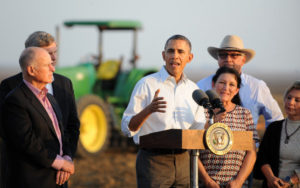
While there are still Republicans who deny that global warming is a real threat, yesterday President Obama traveled to ground zero, the latest example of man-made environmental disasters — the worst drought in California in the last 100 years.
The president warned that weather-related disasters will only get worse and the nation must change the way it approaches environmental issues.
Even if the U.S. takes action now to curb pollution, the planet will keep getting warmer “for a long time to come,” thanks to greenhouse gases that have already built up, Obama said.
“We’re going to have to stop looking at these disasters as something to wait for. We’re going to have to start looking at these disasters as something to prepare for,” he said.
In addition to more than $200 million in emergency aid to California, Obama announced a series of measures intended to ease the impact of climate change, including $1 billion for a proposed “climate resilience fund” to invest in research and pay for new technologies to help communities deal with the impact of the changes.
The proposal is part of the president’s 2015 budget to be sent to Congress next month. Among its goals, according to the White House, is to:
• Invest in research and unlock data and information to better understand the projected impact of climate change and how we can better prepare our communities and infrastructure.
• Help communities plan and prepare for the impact of climate change and encourage local measures to reduce future risk.
• Fund breakthrough technologies and resilient infrastructure that will help us to withstand a changing climate.
As part of the plan, the U.S. Department of Agriculture is establishing climate hubs across the country designed to help farmers, ranchers, and communities get the information they need to make informed decisions about the changing climate.
“We really understand a number of the reasons that global climate change is increasing the intensity and the frequency and the life of drought in drought-prone regions,” John Holdren, director of the White House Office of Science and Technology Policy, told reporters on a conference call Thursday night. “This is one of the better-understood dimensions of the relationship between global climate change and extreme weather in particular regions.”
But despite its ambitions, most observers expect the proposal to face fierce resistance from Republican lawmakers, who don’t like any form of new federal spending and many of whom still claim global warning is a hoax.
But environmentalists were excited about the proposed measure.
“Communities across the country are struggling with drought, a longer fire season, increasing summer temperatures, more heat waves, and rains coming in the form of deluges,” Angela Anderson, director of the Climate and Energy Program at the Union of Concerned Scientists (UCS), said in a statement. “Congress can no longer ignore the consequences of climate change. The president is now putting a plan on the table that Congress needs to fund.”
As he toured parts of California devastated by the drought, Obama called on federal facilities in the state to limit water consumption immediately.
“These actions will help, but they’re just the first step,” he said. “We have to be clear. A changing climate means that weather-related disasters like droughts, wildfires, storms, floods, are potentially going to be costlier and they’re going to be harsher.”
The president nudged Congress to pass Democratic legislation backed by California’s senators, Dianne Feinstein and Barbara Boxer, which would pour $300 million into emergency aid and drought-relief projects, upgrade city water systems and water conservation, and speed up environmental reviews of water projects, among other steps.
“The impact of a drought is far-reaching,” Brian Fuchs, a climatologist at the National Drought Mitigation Center at the University of Nebraska, told Al-Jazeera America.
Less runoff from melting mountain snow flowing down to rivers makes the water temperatures rise and the levels drop, he explained.
“That will impact aquatic vegetation and aquatic species,” Fuchs said. “There’s a ripple effect that some people will never see.”
The view from satellite images confirms the vegetative stress in parts of the West, especially in California, with suffering crops and lack of forage causing ranchers to cull their herds.
As of Feb. 4, almost half of the nation’s winter wheat, 40 percent of domestic cattle and 30 percent of corn acreage were affected by the drought, according to the USDA.
In addition to another $60 million in federal aid for food banks in California, the government will open 600 summer-meal program sites.
“The president definitely recognizes that drought not only affects producers but families,” said Secretary of Agriculture Tom Vilsack. “A lot of folks will not be employed.”
The salmon industry is especially devastated by drought.
“Tens of thousands of Californians and Oregonians rely on salmon to come out of California’s Central Valley,” John McManus, executive director of the Golden Gate Salmon Association, told Al-Jazeera. “It provides a lot of work and a lot of food to a lot of people.”
Because the water levels are so low, weak and warmer river flow will fail to flush the young fish out into the ocean, leaving them more prone to predators.
“Salmon are lousy swimmers,” McManus said. “We could see the impact next year, and 2016 is hanging in the balance.”
While he is in California, the president is taking a rare meeting outside of the White House with Jordan’s King Abdullah II at the Rancho Mirage estate Sunnylands, for talks covering the Mideast peace process, Syria and other issues.
Obama will stay in California through Presidents Day weekend, where he is expected to get in some golf at the estate without the first lady, who stayed home.


