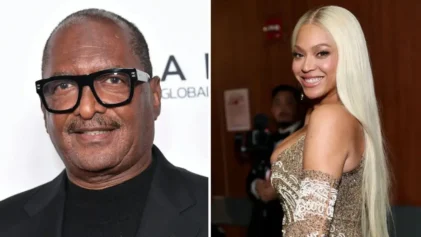
Last Friday, Beyoncé dropped a new self-titled album—14 songs and 17 accompanying music videos—all without a hint of prior promotion. Apple reported that the album “Beyoncé” is iTunes’ fastest-selling digital album, with more than 800,000 sold in just three days.
The project’s release date was kept under such a tight lid that even some of the singer’s closest collaborators were caught off guard when it was unveiled.
“My DJ came upstairs into my studio and told me Beyoncé just dropped her album,” producer Hit-Boy, who produced the whiplash album track “Flawless,” and assisted on several others, including “XO,” told ELLE.com. “I was just as surprised as everybody else!”
So how did Beyoncé’s team keep this massive project so hush-hush?
In an interview with ELLE, Beyonce’s fashion director and confidant of 15 years Ty Hunter said, “Well, people knew things were going on but the thing is, we’re such a tight-knit family, those on set at the video shoots were, for the most part, asked to sign non-disclosure agreements”.
According to Hunter, the project has been in the works for nearly two years. For him, the project was most stressful not only because he had to curate Beyoncé’s looks for 17 videos, but also because the clothes he hand-selected with Beyoncé, and then ordered by phone, often had to be sent overseas on a moment’s notice. “I’d have it sent and pray that the pieces and the packages would be received by different hotels in other countries,” he explained, adding that he felt “blessed” to have five premier stylists—B. Akerlund, Lysa Cooper, Marni Senofonte, Karen Langley, and Raquel Smith—assisting him.
Jonas Akerlund, who directed the videos for “Haunted” and “Superpower,” first learned about the project in May when Beyoncé invited the Swedish filmmaker to her Mrs. Carter show in Stockholm. “We listened to some of these songs already back then. And then we started to talk about different ideas,” he revealed. As timing would have it, Akerlund was one of the first directors to meet with the singer, but come September, was the last to shoot his videos. “So actually at the very end of it [Beyoncé’s team] were all waiting for my videos to be finished,” he says with a laugh. How soon before the album release did Akerlund turn in his finished videos? “Maybe 24 hours,” the director admitted.
Keeping the project under wraps was “business as usual” for Akerlund. Still, the filmmaker, who has worked with everyone from Lady Gaga to Madonna and The Rolling Stones, was impressed that everyone involved stayed mum. “The fact that she managed to do 17 videos and the music and have it all ready, it’s just proof that everybody that works for her truly believes in what she does,” he said. “Everybody that works for Beyoncé really loves her.”
The scope of the project, with videos being shot over this past year, from such far-flung places as Australia, Brazil, and France as well as in the United States, remains baffling to Hunter. “When you finally see the final project, you’re just like ‘I can’t believe we survived it,’” he says. “We were able to pull this off which is unheard of. It’s just a celebration for the whole team.”
“It was great for music,” he added. “You’re giving people a whole package where they couldn’t judge it before. It was amazing for all of us.”
Hunter is more direct in his assessment: “This is history that has been made!”
Original Story: Elle.com