
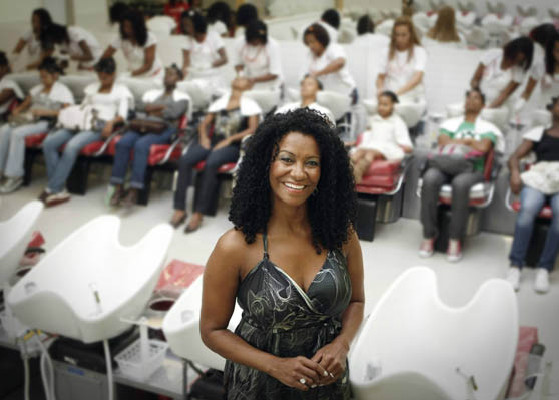
Heloisa Assis
Heloisa Assis comes from a poor family of 13 children and grew up in a favela in Rio de Janeiro, Brazil. When she was 9 years old, she began to work as a maid and cleaner to help bring money home. While growing up, Assis felt pressured to straighten her hair but eventually grew tired of it.
“I wasn’t happy about it, but I kept straightening my hair until I was 21. Then I said – enough. I want to wear my hair naturally,” she said.
Despite a large population of people of African descent living in Brazil, many of the salons catered to women of European descent. After a longtime struggle finding natural hair salons, Assis left her job as a domestic maid and convinced her husband to sell the Volkswagen Beetle he used as a taxi. They invested $1,500 to open a small beauty parlor in 1993.
That was the beginning of Beleza Natural – Portuguese for “natural beauty.” Today, the company has 12 shops in Rio, Bahia and Espirito Santo. It started with four employees. Now there are more than 1,400.
According to Assis, “We were offering something innovative that didn’t exist in the market.”

Kim Foster, For Harriet
Harvard University graduate Kim Foster launched a website during her undergraduate years to provide an online community for women of African descent to engage in honest dialogue about the complexities of Black womanhood.
Foster offers women the opportunity to read and submit engaging, timely, and thought-provoking articles about Black womanhood that spark much-needed conversations on three different websites: For Harriet, “celebrating the fullness of Black womanhood”; Shine, “where Black women take center stage”; and Soar, “elevating the creative brilliance of Black women.”
According to the Foster’s website, “For Harriet seeks to raise the level of discourse surrounding Black women and provide a thoughtful, collaborative alternative to mainstream media representations of Black womanhood. Thus, For Harriet seeks to explore all parts of who we are and who we hope to be.”


