Black Americans were nearly four times as likely as whites to be arrested on charges of marijuana possession in 2010, even though the two groups used the drug at similar rates, according to new federal data.
This disparity had grown steadily from a decade before, and in some states, including Iowa, Minnesota and Illinois, blacks were around eight times as likely to be arrested.
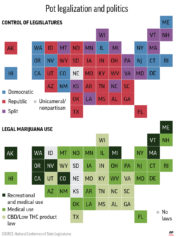
During the same period, public attitudes toward marijuana softened and a number of states decriminalized its use. But about half of all drug arrests in 2011 were on marijuana-related charges, roughly the same portion as in 2010.
Advocates for the legalization of marijuana have criticized the Obama administration for having vocally opposed state legalization efforts and for taking a more aggressive approach than the Bush administration in closing medical marijuana dispensaries and prosecuting their owners in some states, especially Montana and California.
The new data, however, offers a more nuanced picture of marijuana enforcement on the state level. Drawn from police records from all 50 states and the District of Columbia, the report is the most comprehensive review of marijuana arrests by race and by county, and it is part of a report being released this week by the American Civil Liberties Union. Much of the data was also independently reviewed for The New York Times by researchers at Stanford University.
“We found that in virtually every county in the country, police have wasted taxpayer money enforcing marijuana laws in a racially biased manner,” said Ezekiel Edwards, the director of the A.C.L.U.’s Criminal Law Reform Project and the lead author of the report.
During President Obama’s first three years in office, the arrest rate for marijuana possession was about 5 percent higher than the average rate under President George W. Bush. And in 2011, marijuana use grew to about 7 percent, up from 6 percent in 2002 among Americans who said that they had used the drug in the past 30 days. Also, a majority of Americans in a Pew Research Center poll conducted in March supported legalizing marijuana.
Though there has been a shift in state laws and in popular attitudes about the drug, black and white Americans have experienced the change very differently.
“It’s pretty clear that law enforcement practices are not keeping pace with public opinion and state policies,” said Mona Lynch, a professor of criminology, law and society at the University of California, Santa Cruz.
She added that 13 states have in recent years passed or expanded laws decriminalizing marijuana use and that 18 states now allow it for medicinal use.
In the past year, Colorado and Washington State have legalized marijuana, leaving the Justice Department to decide how to respond to those laws because marijuana remains illegal under federal law.
Read more on the NY Times