WASHINGTON (AP) — African-Americans and Hispanics breathe in far more deadly air pollution than they are responsible for making, a new study said.
A study looked at who is exposed to fine particle pollution — responsible for about 100,000 American deaths a year — and how much different races are responsible for the pollution based on their buying, driving and living habits.
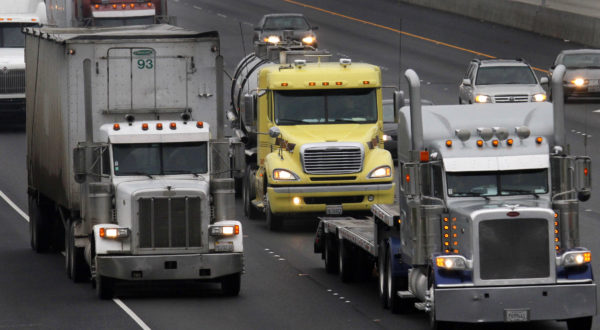
FILE – In this Dec. 17, 2010 file photo, trucks make their way in Livermore, Calif. (AP Photo/Ben Margot, File)
Scientists calculate that Hispanics on average breathe in 63 percent more of the pollution that leads to heart and breathing deaths than they make. For African-Americans the figure is 56 percent, according to a study published Monday in the Proceedings of the National Academy of Sciences.
On the other hand, non-Hispanic whites on average are exposed to 17 percent less air pollution than they make.
“Even though minorities are contributing less to the overall problem of air pollution, they are affected by it more,” said study co-author Jason Hill, a biosystems engineering professor at the University of Minnesota who is white. “Is it fair (that) I create more pollution and somebody else is disproportionately affected by it?”
This pollution comes from gases from smokestacks, tailpipes and other places that then solidify into fine invisible particles small enough to pass through lungs and into bloodstreams. These particles, more than 25 times smaller than the width of a human hair, pose the greatest risk to people’s health, the U.S. Environmental Protection Agency says.
While other studies have shown minorities living with more pollution, this study is one of the first to combine buying habits and exposure into one calculation of inequity, Hill said.
Hill and colleagues looked at pollution from highways, coal-fired power plants, hog farms and other sources.
They then looked in a large scale at who is driving more, buying more goods and food, spending more on property and using more electricity, then traced those purchases to end users.
“On average whites tend to consume more than minorities. It’s because of wealth,” Hill said. “It’s largely how much you buy, not buying different things.”
Of 103,000 particle pollution deaths a year, 83,000 can be traced to the activities of people in the United States — not government and not goods exported elsewhere, the study said
Several outside experts praised the research.
“These findings confirm what most grassroots environmental justice leaders have known for decades, ‘whites are dumping their pollution on poor people and people of color’,” said Texas Southern University public affairs professor Robert Bullard, who was not part of the research. Bullard, often called the father of environmental justice, is African-American.
Bullard said his and other past research shows that African-Americans are 79 percent more likely than whites to live where industrial pollution is highest, with people of color overrepresented near Superfund sites and oil refineries.
He said there are far more mostly minority schools within 500 feet of major highways than mostly white schools.
“Being able to quantify the inequity is a key step toward addressing and reducing inequity,” said Christopher Frey, a professor of environmental engineering at North Carolina State University, who is white and not part of the research.
One bright spot is that in recent decades the air has been getting cleaner in general, Hill said. However, his study stopped in 2015 and EPA data shows an uptick in fine particle pollution in 2017. But even with the cleaner air, it is still inequitable, Hill said.