A City Council committee in New York on Monday unanimously approved a bill that would stop tests for marijuana from being conducted on people on probation.
The decision was made following Public Safety Committee Chair Donovan Richards proposing the bill back on February 19. Since then, it has moved swiftly through the legislative process, according to the New York Daily News.
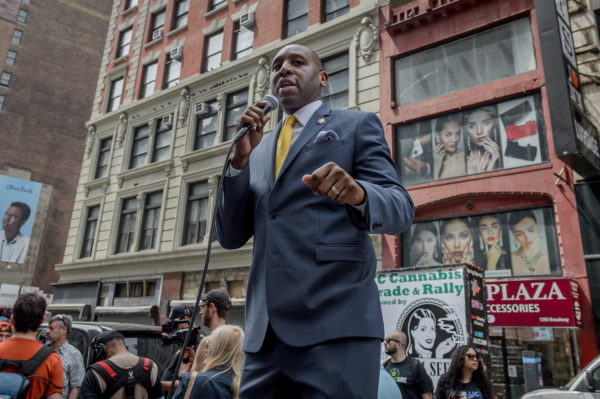
Council Member Donovan Richards – The NYC Cannabis Parade and Rally, New Yorks longest running annual pro-cannabis demonstration, returned for its 47th year. (Photo by Erik McGregor/Pacific Press/LightRocket via Getty Images)
“This bill will close one trap door that trips people up,” Richards said to the paper Monday. “Too many people come out, they are trying to do better, and they get busted for marijuana and go back into jail or prison. This sets them back.”
New York City conducts hundreds of tests for marijuana, according to the Daily News. The paper obtained figures showing 20,000 adults and juveniles were on probation in 2018. Of that amount, 600 probationers were tested for marijuana and during that year, and around 270 were arrested again on marijuana charges.
“Remember, these are people who are otherwise not violating their probation conditions. That means they are working or seeking work, avoiding police contact and following all the conditions set-out for them by their probation officers,” Richards, who last year walked the annual pro-cannabis NYC Cannabis Parade and Rally, said to WBCS. “These are people who don’t need marijuana testing to keep them on a straight path.”
He told the Daily News that for every 10 people who complete parole, nine are sent back behind bars, typically for technical violations similar to marijuana.
The committee chair also said five ex-Probation commissioners and former Chief Judge of New York State Jonathan Lippman have agreed that a change needs to occur in the policy.
Those former commissioners — Martin F. Horn, Michael Jacobson, James Payne, Raul Russi and Vincent N. Schiraldi — made their stance known last fall in a written statement Schiraldi read to the New York State Assembly’s Standing Committees on Codes, Health, Governmental Operations, and Alcoholism and Drug Abuse in October 2018.
“What we want is that people under supervision lead law-abiding lives and meet their obligations as citizens,” read the statement. “As long as they do, we should be no more concerned about them using marijuana than we are of them having a glass of wine. We think extra protections are warranted with respect to marijuana use given the stark racial disparities in both general revocations and arrests for marijuana in this state.”