
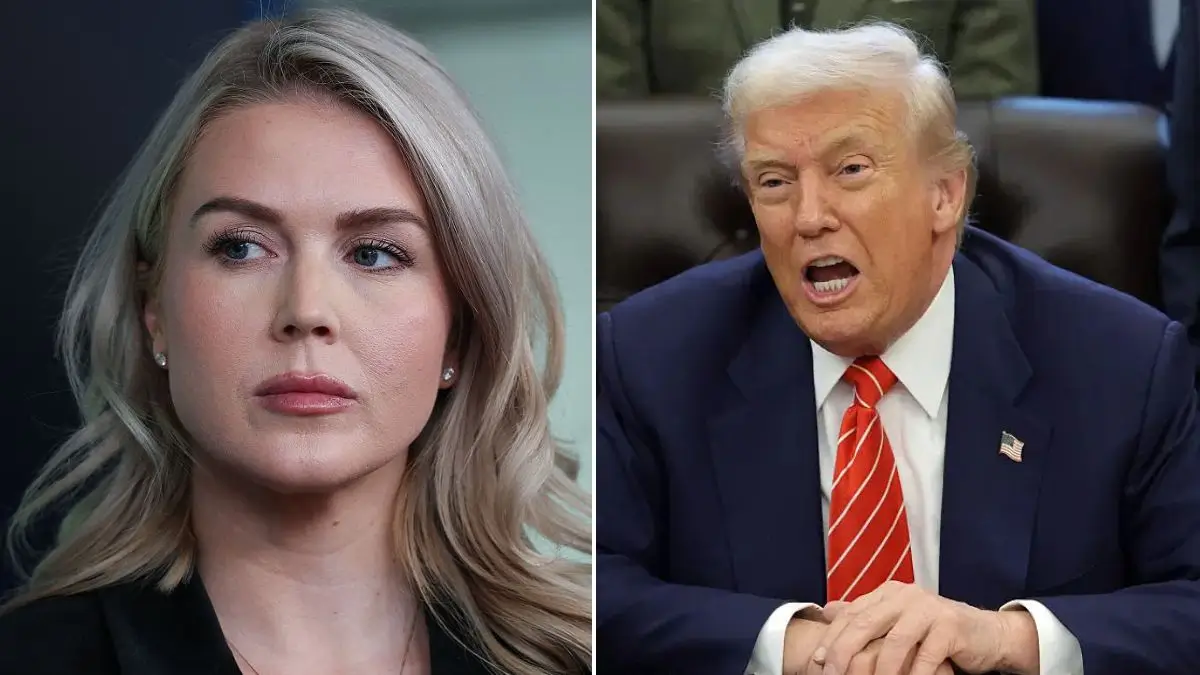
Former White House Press Secretary Karoline Leavitt has put President Donald Trump and his administration in legal jeopardy.
Her former vitriolic jab about big law and its “lies” is coming back to haunt Trump and his White House.
A judge ordered a search of the Trump administration’s servers as part of a lawsuit filed by the American Bar Association (ABA) over the president’s alleged revenge campaign against prominent U.S. law firms.
As part of that campaign, Leavitt claimed in April of 2025 that Trump was holding “big law accountable for its ‘lies,’” according to The Wall Street Journal.
On Monday, U.S. District Judge Amir Ali ordered Trump to release any documents, emails, or memos related to Leavitt’s comments or, at the least, claim executive privilege, Raw Story reported.
“President Trump’s policy team is executing on his directive to hold Big Law accountable for their weaponization of justice and their lies, and the strategy has proven tremendously successful,” the Trump sycophant told the WSJ.
Shortly after Trump retook office in January of 2025, he issued a series of executive orders and other memos aimed at major U.S. law firms. Critics say the president targeted the firms’ political ties, former investigators, past representations, and DEI (diversity, equity, and inclusion) policies.
Legal experts described the campaign as “an unprecedented use of executive power against private legal practices.” It also caused a rift between firms that chose to settle and those that sued.
Nine law firms made a deal with the Trump administration to provide $940 million in pro bono work after the president issued the executive orders.
Then, in June of last year, the ABA sued over Trump’s campaign of retribution using Leavitt’s own words as part of its suit.
“Big Law continues to bend the knee to President Trump because they know they were wrong,” she said in a statement last April, the ABA wrote in its suit.
The judge wrote in his order that White House documents “may shed light on the government’s motivation” and that memos “could establish the existence of a policy of intimidation.”
The administration has denied that it waged an intimidation campaign against law firms.
The judge limited the search of White House emails to those between Feb. 13 and April 18, 2025, when Trump signed five executive orders against law firms, Raw Story reported.
Some of the penalties Trump’s orders imposed include the suspension or review of active national security clearances law firms or their attorneys held. The orders also restricted or barred attorneys’ access to federal buildings, government employment, access to government officials, and even conducting any business with the administration.
In addition, Trump’s orders directed federal agencies to review or end contracts and ban federal contractors from using the firms he was targeting.
Since the ABA filed the suit, federal courts have blocked essential provisions of the orders on constitutional grounds.
By March of this year, the Department of Justice began the process of dropping appeals on the rulings, meaning it would follow the orders and end sanctions against the firms that fought back. Then the agency suddenly reversed course, deciding to challenge the rulings after all.
Trump’s actions have sparked a wider legal debate. NPR reported that scholars and bar groups have warned that Trump’s vendetta against law firms he doesn’t like could hamper representation for clients on the president’s hit list.
There are also questions about whether Trump’s orders are even enforceable and whether the settlement agreements the nine firms signed are legal.


