
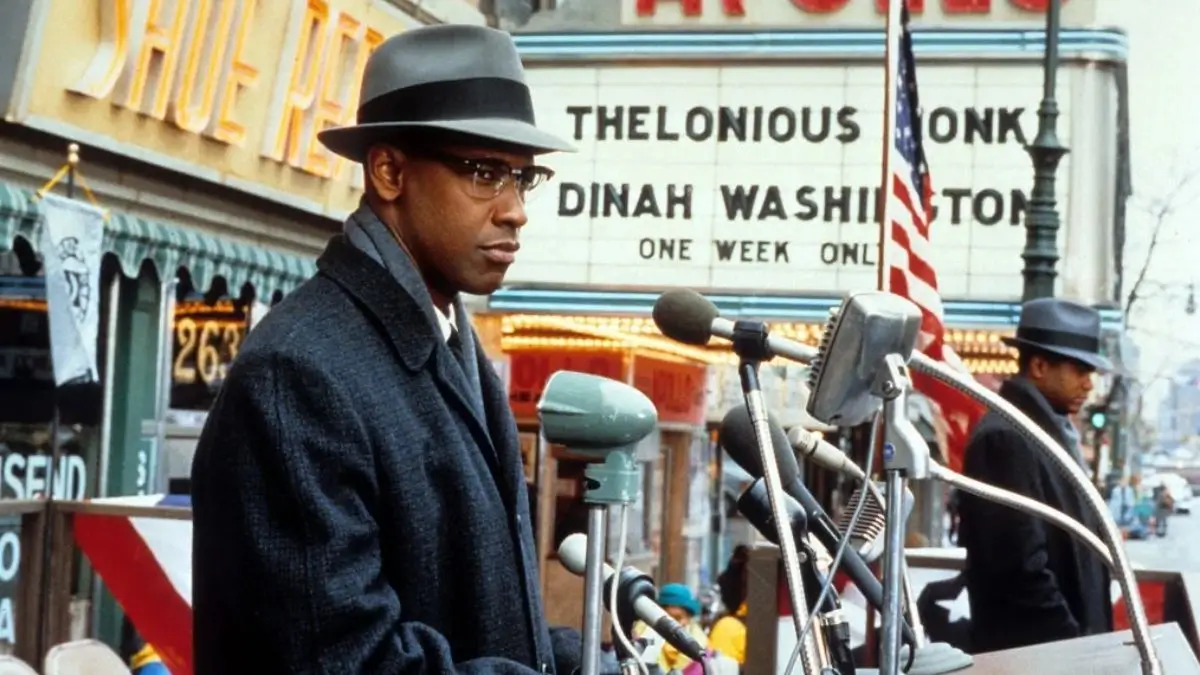
Legendary filmmaker Spike Lee rarely misses a chance to celebrate his work. This time, though, the trip down memory lane came with a thank-you note fans didn’t see coming.
The Brooklyn native filled his Instagram with tributes as “Malcolm X,” his epic biopic starring Denzel Washington, marked its 34th anniversary on Nov. 18.
Lee shared classic scenes, a signed book pulled from his company’s archives, and a new piece of art he titled simply “Three Peat.”
But one caption pulled back the curtain on a chapter of the film’s history that even some longtime fans had never heard.
“Malcolm X” came out in November 1992. It follows Washington as the Black liberation leader from his days as a street hustler through his rise in the Nation of Islam, his pilgrimage to Mecca and his assassination in 1965.
Washington had already played Malcolm on stage, and he carried the film through every chapter. His performance earned him a best actor Academy Award, though he lost to Al Pacino for “Scent of a Woman.”
In 2010, the Library of Congress selected the film for the National Film Registry, cementing its place as one of the most important biopics ever made.
Getting it to the screen was another story. In February 1992, The Washington Post reported that cost overruns had pushed the company insuring the film to take “the rare step of assuming financial control of the movie.”
At the time, producer Marvin Worth played down the drama and said the team had shot everything it planned to. Lee kept creative control.
Lee later made it clear the trouble started long before that. “We didn’t have enough money,” he told Democracy Now! in 2023.
He said he put half his salary into the film and that Warner Bros. let the bond company take over. Postproduction staff, he said, started getting termination letters.
Length was another sticking point. According to The Ringer, executives watched a four-hour cut in April 1992 and wanted it trimmed. Lee refused to cut it down to their liking, and the finished film runs three hours and 22 minutes.
With the studio holding back and his own money already in the film, Lee needed help elsewhere. So he started making calls.
In his anniversary post on IG, he finally laid out who answered.
Lee thanked Allah for “these individuals who gave me funds so I could finish the film. The money came with no strings attached says, per DemocracyNow.org.
“They couldn’t get any money back. It wasn’t a tax write-off,” said Lee at an 2023 address. This had to be like, “Here, take it. Take it. And the first person I called was Bill Cosby,” said Lee.
He also named Bill Cosby, Michael Jordan, Magic Johnson, Oprah Winfrey, Tracy Chapman, Prince, Janet Jackson, and Peggy Cooper Cafritz, the late Washington, D.C., arts patron
This isn’t the first time Lee reminisced about how Magic Johnson and Michael Jordan helped fund the film and credited the power of unity.
The visual story teller has even recalled telling Jordan how much Johnson gave, which got Jordan to open his checkbook too.
“One thing about Michael, he don’t like to lose nothing. Very competitive. So I just let it slip how much Magic gave,” Lee explained.
“Oh, oh, oh, Ms. Oprah Winfrey — sorry, sorry. She’s in there. I told you I get the — so I let Michael — I said, “Magic gave…” He said, ‘Magic gave what?’ Boom! So now we had the money, and I had the money to rehire the crew.”
On Malcolm X’s birthday in May 1992, Lee held a press conference at Harlem’s Schomburg Center to announce the gifts.
By his account, Warner Bros. stepped back in and paid for the rest of the film the very next day.
Fans answered with gratitude of their own. One person singled out two names on the list, writing, “Tracey Chapman & Janet Jackson I would have never guessed.” Another added, “I also thank God for the people who gave you the funds.”
Others shared what the film meant to them. One fan said it gave them “a sense of pride, understanding, and fortified purpose” at 16.
Another called it “that very high standard” for what a biopic should be. Under a clip Lee posted of Washington with the late Christopher Plummer, one commenter reopened an old wound: “Got robbed of that Oscar.”
Lee’s company also used the anniversary to promote signed copies of the book Lee wrote with the late journalist Ralph Wiley. The post described the book as documenting the “rocky road” to making the film.
Meanwhile, the “Three Peat” piece by artist Zagresilla shows Lee in a red X cap beside two men in matching caps, and it had fans begging him to bring the hats back.
Thirty-four years later, the list Lee keeps sharing is a reminder of who finished “Malcolm X”: not a studio, but Black stars who refused to let it die.


