
After a surge in Black voter turnout helped propel Democrats to victories across the country in the midterm elections, giving the party control of both chambers of Congress and flipping several statewide offices, including governorships, a pressing question remains: What will Democratic leaders deliver for the Black voters who helped put them in power?
Hopes are running high for the newly elected Democratic majority, as voters have pressed the party to address the rising cost of living, make health care more affordable and end the war in Iran, which has contributed to higher gasoline prices and mounting economic pressures.
But those hopes are tempered by the political realities facing Democrats: President Donald Trump has vowed to veto legislation that reaches his desk, while divided party control in some state governments could complicate efforts to advance their agenda at the state level.
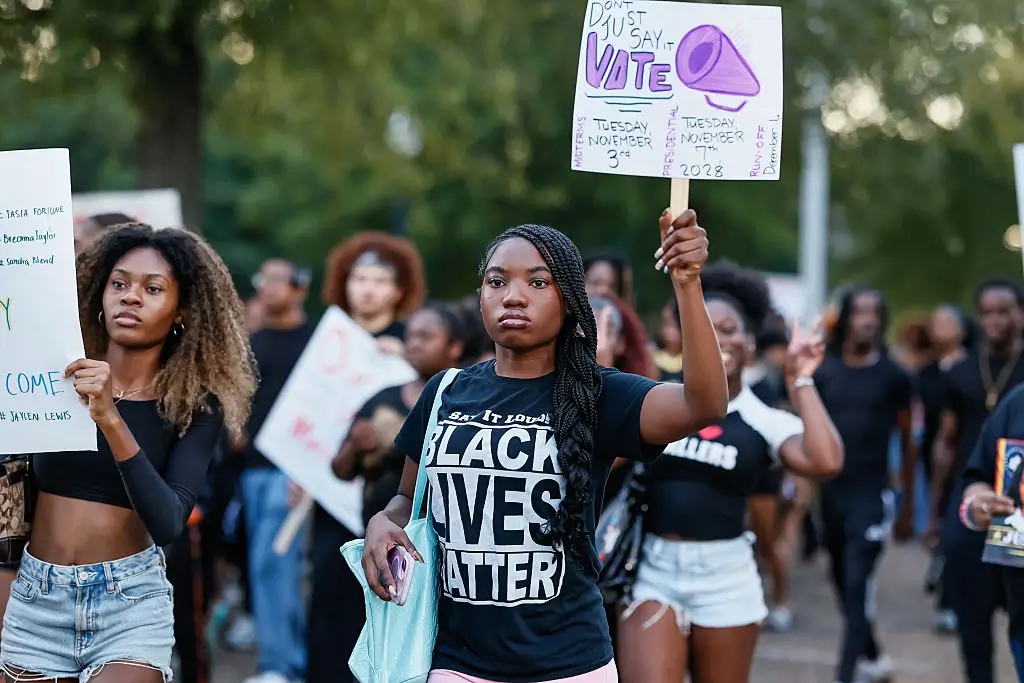
Dorian Warren, co-president of Community Change, a national progressive nonprofit that works to build the capacity and political power of low-income people, told Atlanta Black Star (ABS) that Democrats elected to state and federal offices in the midterms have an obligation to fight for and deliver results for the Black voters who helped propel them to victory.
Nearly 9 in 10 Black voters supported Democratic candidates in U.S. House races, up from roughly 8 in 10 who supported Kamala Harris in the 2024 presidential election, according to the Associated Press Voter Poll.
“Black voters saved the Democrats’ butts and helped them to fire up a whole bunch of people … I would argue there is something owed to Black voters,” Warren said. “I think there is a question on the table for every single Democrat: What are you going to do to ensure that Black people and therefore all people have voting rights and representation that matters? And if they don’t have an answer to that, then I think we have to have some tough conversations about voting people out again.”
Warren said Democrats must also deliver on the affordability agenda, “given that Black households are going to feel the Medicaid and SNAP and federal jobs cuts first,” and will strongly benefit from any progress on housing affordability, increasing wages, and improving childcare benefits.
House Minority Leader Hakeem Jeffries, who is widely expected to be nominated as the Democrats’ candidate for House speaker this week, unveiled a first 100-days agenda on Nov. 4 focused on lowering costs and holding the Trump administration accountable for what he described as corruption and self-dealing.
Jeffries says House Democrats “must act to reverse the Medicaid cuts, restore SNAP funding, extend the Affordable Care Act tax credits, eradicate the Trump tariffs and stop the reckless war of choice in Iran.”
House Democrats will also seek to investigate questionable stock investments by members of the Trump administration, including trades that could affect consumer markets, and push for a ban on congressional stock trading. Those priorities have also been championed by Senate Minority Leader Chuck Schumer, who is facing a leadership challenge from Maryland Sen. Chris Van Hollen.
Schumer, who said he has been coordinating with Jeffries on setting the agenda for the 120th Congress, called for legislation to restore expanded Affordable Care Act (ACA) premium subsidies that expired at the end of 2025, reverse Trump’s trade tariffs and undo $1 trillion in cuts to Medicaid and hospitals, The Hill reported.
Reversing Medicaid cuts and new work requirements under H.R. 1, the One Big Beautiful Bill Act, could help restore health coverage to millions of Black Americans, who account for more than 20% of the roughly 73 million people enrolled in Medicaid and the Children’s Health Insurance Program (CHIP). Restoring the enhanced Affordable Care Act (ACA) premium tax credits for people earning up to 400% of the federal poverty level could also help lower insurance costs for 1.1 million Black Americans, according to a report by Community Catalyst, a nonprofit focused on racial equity and health justice.
But the Democratic majorities in the House and Senate don’t mean that efforts to pass such affordability-focused legislation will come without strong pushback from Republicans, or that they will succeed.
Democrats have gained at least 42 seats in the House and currently hold a 256–171 majority over Republicans, according to the latest tally. Eight races remain uncalled, and the final seat count could shift as the remaining votes are counted. The party is on track to have its largest House majority since 2008.
With Scott Colom’s historic victory in Mississippi, Democrats now hold at least 55 seats in the Senate, compared with 44 for Republicans. They could expand that majority to 56 seats if Democrats win Alaska’s remaining uncalled Senate race.
Democrats can pass legislation with a simple majority in each chamber — 218 votes in the House and 51 in the Senate, assuming full attendance. But those margins fall short of the two-thirds majorities needed to override a presidential veto: 290 votes in the House and 67 in the Senate when all members are present and voting. They would also generally need 60 votes in the Senate to invoke cloture and end debate on most legislation, overcoming a Republican filibuster.
Though Trump has expressed a willingness to negotiate with Democrats on certain issues, he has also told reporters he plans to become “Mr. Veto,” blocking Democratic-sponsored legislation he opposes. Most political observers do not expect the president to compromise on the central provisions of H.R. 1, his signature legislative achievement, which became law through budget reconciliation in July 2025. The legislation extended and modified tax cuts, increased defense and border security funding, and made substantial cuts to federal health care and social safety net programs.
Still, Schumer told Democratic colleagues last week that he plans to use the budget reconciliation process next year to circumvent Republican filibusters and force Democratic-passed bills through the Senate, The Hill reported.
That strategy could put Trump in the position of vetoing popular legislation while forcing some Republican lawmakers to go on record opposing measures that voters want the new Congress to enact. Those votes could become political liabilities in the 2028 presidential and congressional elections, when voters have an opportunity to hold lawmakers accountable for their decisions.
“If they don’t make sure that Americans have affordable and accessible health care, if they don’t save these rural hospitals,” Mississippi Senator-Elect Colom told CNN anchor Dana Bash about congressional Republicans on Monday, “if they think 2026 was bad, 2028 will be a wipeout.”
Colom, who will become Mississippi’s first Black U.S. senator since Reconstruction, also expressed optimism that some Republican senators, including Josh Hawley of Missouri and Lisa Murkowski of Alaska, would support legislation aimed at protecting health care access and making coverage more affordable.
“They understand that their constituents are the ones who are losing health care. It’s their hospitals that are at risk of closing,” Colom said.
Incoming Congressional Black Caucus Chair Rep. Troy Carter of Louisiana said that, regardless of how party-line votes unfold in the next Congress, the CBC must prioritize issues including affordability, health care and environmental justice, while working to restore voting rights when the new Congress convenes in January.
Carter told Politico that the 67 members, who will make up the largest caucus in its history, plan to push for passage of the John R. Lewis Voting Rights Advancement Act. The legislation would restore and strengthen key federal voting rights protections weakened by congressional action and Supreme Court decisions over the past decade.
That includes the “preclearance” requirement that states or jurisdictions with a history of discrimination must get federal approval before changing voting laws. The proposed bill would also restore the right of minority groups to bring joint coalition claims against racial gerrymandering and other voting rights violations.
Rep. Greg Meeks (D-N.Y.), who chairs the CBC’s political arm, told Politico that despite Congress’s previous failure to advance voting rights legislation, he believes the John R. Lewis Voting Rights Advancement Act will pass the House and that “we’ll have the advocates and the individuals to put it forward to get it passed in the Senate.”
Asked about the prospect of Trump vetoing the bill, Meeks said, “The burden will be on the president. But if he continues with his tariffs, if he continues with trying to take away who we are as African Americans by trying to take away our history and destroy the legacy of our leaders, then we’ll have a battle.”
While Warren echoes the push among Democrats in Washington to “reverse HR 1,” he also thinks “we can be more expansive” by expanding SNAP, increasing the child tax credit “like we did in 2021, which actually helped to reduce child poverty and especially Black child poverty by almost half in six months,” and “putting Medicare for All on the table. Let’s do a roll call vote so we can see who votes yes and who votes no on expanding healthcare to ordinary people.”
Warren noted that several newly elected Democratic governors campaigned on expanding Medicaid, including Georgia’s Keisha Lance Bottoms and Texas’ Gina Hinojosa. He said they now have an opportunity to go beyond reversing the damage caused by H.R. 1 and take steps to expand health care coverage.
“They have an opportunity to expand coverage, not just to reverse harms that will be done,” Warren said.
In a news conference the day after the election, Bottoms, who will become the nation’s first Black woman governor, said she intends to deliver on her campaign promises, including addressing the cost of living and affordability, expanding access to health care and mental health services, easing the burden on caregivers, and addressing the needs of public schools and teachers.
“We heard the people loud and clear,” she said.
One Black Georgia voter hoping that Bottoms will follow through on her campaign promises is Claudia Benjamin, 63, who runs a home-based family childcare service in Lawrenceville.
Benjamin told ABS that many of the families she serves rely on a state program that subsidizes child care but have struggled to pay their bills in recent years. Some have withdrawn their children from her program, she said, reducing her income and making it harder for her to meet her own financial needs.
The Georgia Child and Parent Services (CAPS) program lost more than $170 million in federal funding in 2024 after COVID-19 relief funds expired, forcing families to resume paying mandatory fees and copayments. The loss of federal funding, combined with a flat state allocation for childcare, contributed to a decline in the number of children served by the program from about 75,000 to roughly 50,000, according to the Georgia Budget and Policy Institute.
“I lose a client and don’t have no income to pay my mortgage or buy food,” Benjamin said. “I got to go to the pantry to make sure I got food in the house to feed me and the daycare children. So I need Keisha to make sure that … we get what we need as far as more income, healthcare and housing.”
Benjamin said that she doesn’t qualify for Medicaid and has to pay for private health insurance, which she struggles to do.
She added that childcare work is demanding, requiring caregivers to provide children and families with “the resources that they need.” But without adequate support themselves, she said, caregivers have little left to give: “We can’t pour it out to anybody.”
During the transition, Bottoms has met with state Rep. Carolyn Hugley, whom Democrats formally nominated on Nov. 12 to become speaker of the Georgia House after flipping control of the chamber for the first time in 22 years.
Bottoms has pledged to work with Hugley, who would become Georgia’s first Black House speaker, to build bipartisan support for Medicaid expansion, a policy that Republican lawmakers have resisted for more than a decade.
Democrats also made gains in the Georgia Senate, where Republicans narrowly retain a 29-27 majority. Democratic Lt. Gov.-elect Josh McLaurin will preside over the chamber, giving Democrats greater influence over the legislative process, including which bills advance for consideration.
During the campaign, Bottoms pledged to expand Medicaid eligibility to cover non-elderly, nonpregnant adults earning up to 138% of the federal poverty level, or about $22,000 a year for an individual. The expansion is expected to extend coverage to hundreds of thousands of Georgians, including many working families and people in underserved communities. She also made lowering prescription drug costs a priority.
Medicaid expansion in the 10 states that have not fully adopted it has become more complicated since Congress passed H.R. 1, according to KFF Health News. The law eliminated a financial incentive for states to expand coverage, imposed new work requirements on many Medicaid recipients and introduced funding restrictions that place greater financial constraints on states that have expanded Medicaid.
Even with the federal government covering 90% of Medicaid expansion costs, compared with roughly two-thirds of traditional Medicaid expenses, Georgia would still face an estimated $200 million to $300 million in additional annual costs, according to the Atlanta Journal-Constitution. That estimate, provided by the Georgia Public Policy Foundation, reflects the state’s share of covering the newly eligible population.
As governor, Bottoms will help shape Georgia’s budget through executive planning and administrative authority, including the power to veto individual budget items. However, she must work with the Legislature to revise the spending plan and secure approval from a majority of lawmakers in both chambers. Georgia’s budget totals $43.3 billion for the current fiscal year.
Warren said the narrow margins allowing Democrats to hold majorities and claim leadership power in Congress and in many statehouses mean that people in Black communities will have to “continue to put pressure on electeds so they continue to hear from us that they will be fired if they don’t deliver.”
That means individual actions, such as calls and emails, and showing up to town halls, he said, and collective action, “like organizing a community meeting and asking your representative to show up and hear from the voters who hired you about how it’s going. Tell us what you have the power to do, and where you need help to deliver the thing you campaigned on.”
Regarding Georgia’s incoming Democratic leadership, which includes eight Black women elected to top statewide offices such as governor, attorney general, secretary of state and insurance commissioner, childcare provider Benjamin said:
“What I need from them is … to make sure that they give us what they promised. If you’re going to turn things around to better the community, I need to be able to be okay to pay my bills, and the [families] need to be okay to pay theirs. We turned the state from red to blue. Let’s make the difference, and let’s get to work. Continue to organize and make a change, and we’ll use our voices to do what we need to do.”
Atlanta Black Star News Editor Nyamkeye Daniel contributed to the reporting of this story.


