
Riding a blue wave on election night, Keisha Lance Bottoms became the nation’s first Black woman elected as state governor, defeating billionaire health care executive Rick Jackson in a closely fought contest.
“You’ve shown that no amount of money will ever —never, ever — overcome the power of the people!” Bottoms said during her victory speech. “Georgia, we sent a message loud and clear: we want a leader who’ll put Georgia first and stand up to all the chaos coming out of Washington, D.C. In these times of division and acrimony, you believed in something foundational, and that is hope.”
The former Atlanta mayor put affordability issues front and center in her campaign, promising to expand Medicaid, raise the minimum wage, develop more affordable housing, lower taxes on groceries, and offer free technical college to Georgians.

She also expended considerable energy defending her record as mayor from 2018 to 2022, including a period of acute social unrest during the pandemic, which her Republican challenger characterized in campaign ads as a fiasco filled with lawlessness in the streets. He also accused Bottoms of “cutting and running” in 2021 when she chose not to run for a second term.
Jackson, who poured more than $200 million of his own wealth into his campaign, promised to run the state like a business, auditing every department for waste and inefficiencies, freezing property taxes statewide and cutting personal income tax in half.
Eschewing Medicaid expansion, he promised to create a low-cost, state-run healthcare plan using federal waivers to expand private coverage options and to tie other public assistance programs to mandatory work or job-training requirements.
6 Key Election Races: Live Results, Major Upsets and Historic Firsts to Watch
He also pledged to deport criminal undocumented immigrants and to be tougher on crime than Bottoms.
“Bad mayors don’t make good governors” was his oft-repeated line about Bottoms in stump speeches and ubiquitous campaign ads.
Georgia voters didn’t buy it, at least not a majority of them. In a record-setting turnout of 4.1 million at the polls in Georgia, about 54% voted for Bottoms, who also became the state’s first Black and first female governor.
Exit polls show Bottoms won 47% of male voters and 55% of female voters, while Black voters gave her 88% of their male vote and 92% of their female vote. Black voters collectively accounted for 28% of ballots cast.
“I’m hoping that more people will have health benefits and that more teachers will get some better pay and perks with Keisha,” said Erica McDonald, 52, a middle school teacher who attended Bottoms’ watch party.
She said she has many immigrant and ESOL students (English Speakers of Other Languages) in her classes and has been concerned for their safety “since Trump amped up the ICE activity.”
She was worried that Jackson, who promised in his campaign ads that “illegal immigrants” would be “deported or departed,” would make life harder for those students and their families.
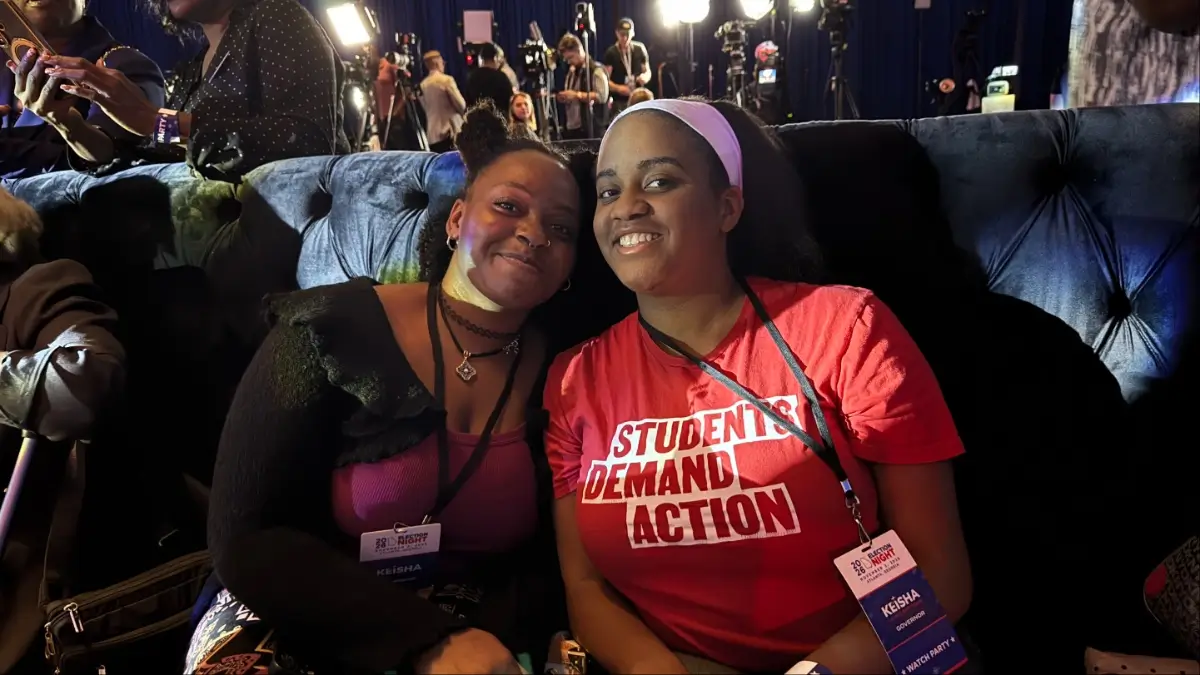
Jasmyn Rhoden, a 19-year-old student at Georgia State University who plans to be a social worker, said she believes a Bottoms administration will usher in more support for public education, including pre-kindergarten for all four-year-olds, and expansion of Medicaid and social safety net programs that “Georgia badly needs.”
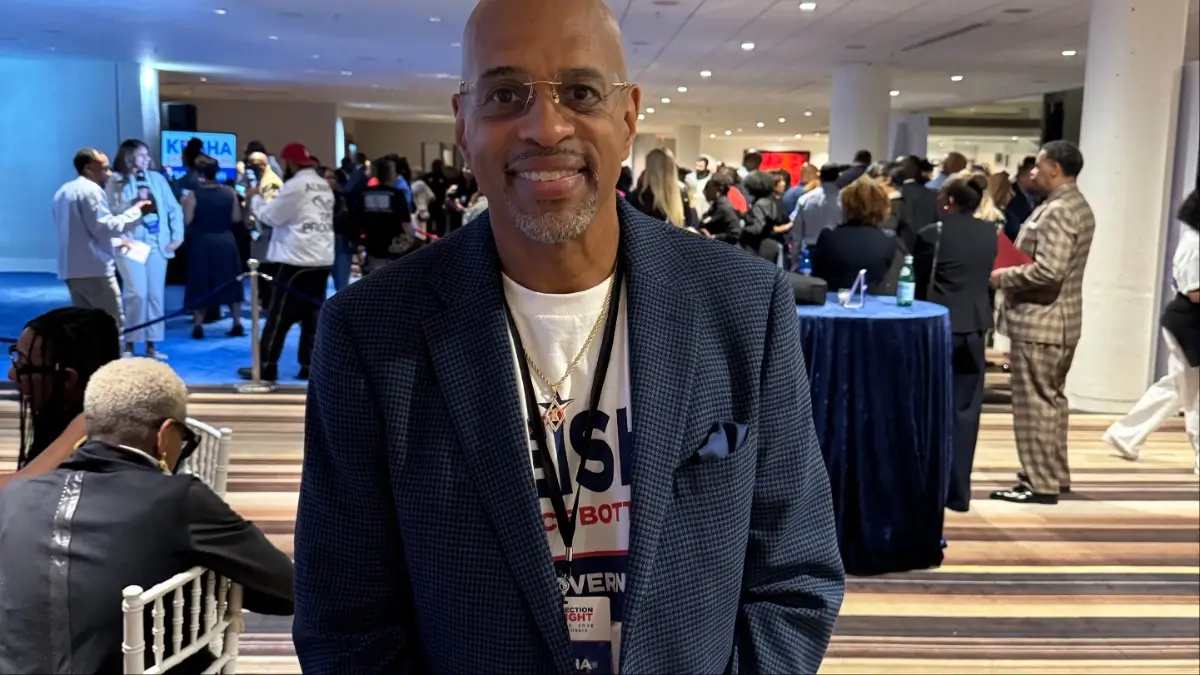
James Harris, 62, a South Fulton resident, said he was happy to hear Bottoms pledge to put a pause on data centers, which he worries “could suck up water, electricity, and other public resources, while driving up our utility bills.”
“She will also help us to rein in health care costs. We need to stop the bleeding,” he says.
With Sen. Jon Ossoff’s convincing win and reelection, Democrats now hold both seats in the U.S. Senate. Democrats also swept every statewide constitutional office, from lieutenant governor and attorney general to secretary of state and agricultural commissioner, all previously held by Republicans.
“You voted, and you voted with whole-ballot energy!” Bottoms told her supporters.
A Democrat has not served as Georgia governor since 2002, and for the last 22 years Republicans have held a majority in both chambers of the state legislature. Bottoms’ victory breaks that trifecta of GOP power.
It was not clear Tuesday night if Democratic candidates had won enough races to take back control of the state House, which Republicans currently control 99-81, but if they do that would give Bottoms considerably more latitude to enact her agenda.
The Democratic sweep in Georgia and Bottoms as governor “means some issues will be discussed differently as a result of her being in power,” said Andra Gillespie, associate professor of political science at Emory University.
“That means health care and Medicaid expansion will get a harder look” by the state legislature, she said, “and Republicans may change their plans for redistricting.”
The Republican-controlled Georgia legislature considered holding a special session to redraw its maps this summer after the Supreme Court’s Callais decision that allows racial gerrymandering, but decided to hold off until at least after the midterm elections.
“Given the national situation, with so many Democrats taking office … I do wonder whether Republicans will stand back and not engage in that kind of gamesmanship, realizing it won’t be welcome from a majority of the electorate,” she said. “A clear message has been sent with these election returns. Even if Democrats don’t control all the levers of power in Georgia, with respect to redistricting, that calculation might be more fraught now.”
Rick Jackson told his supporters that he had called Bottoms “to congratulate her on winning and becoming the governor-elect of Georgia. Tonight, the voters spoke … and I respect their decision. This was a hard-fought election. Keisha Lance Bottoms deserves our congratulations and our prayers as she prepares to take office.”
Bottoms, in turn, told her supporters that when she spoke to Jackson, “We agreed together that we will continue to support foster children across this state. And no matter who you voted for tonight, I will be a governor for all of Georgia.”
Gillespie noted that while Bottoms is making important history as the country’s first Black female governor, her victory came along with the election of at least three other Black governors —Democrats Wes Moore in Maryland and David Crowley in Wisconsin, and Republican Byron Donalds in Florida — making them only the fourth, fifth, sixth, and seventh elected Black governors in the United States since Reconstruction.
“The emergence of several Black governors who will now serve at the same time is truly remarkable as well,” she said.


