
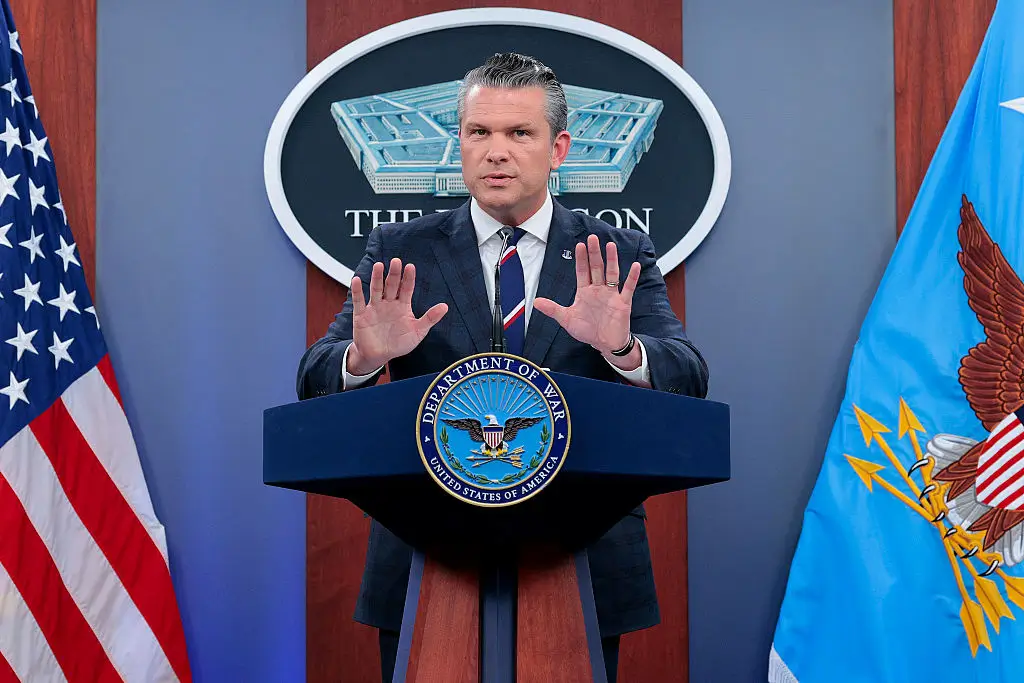
Defense Secretary Pete Hegseth has spent months defending his handling of the Iran war. But a new report alleges Pentagon officials repeatedly ignored Iranian drone warnings before an attack killed six U.S. service members in Kuwait.
A former top Pentagon spokesperson is also urging Hegseth to resign, arguing that his leadership is hurting President Donald Trump politically.
The Atlantic reports that senior U.S. officers repeatedly warned commanders about Iran’s drone capabilities. They urged commanders to deploy Ukrainian-developed technology to protect American troops. Commanders allegedly ignored those warnings before a March 1 strike killed six American soldiers and wounded dozens more.
Hegseth faces growing impeachment calls and a whistleblower complaint from a wounded soldier. Former allies are also publicly criticizing his leadership.
Journalist Simon Shuster’s report details how U.S. officers studied Ukraine’s success against Iranian-designed Shahed drones. They recommended similar defenses for U.S. military installations.
Ukraine developed inexpensive drone interceptors while fighting Russia, which acquired Shahed drones from Iran in 2022. U.S. personnel in Germany began training with the technology in fall 2025. Officers then documented how the military could deploy it elsewhere.
Officers completed one report in December 2025. It circulated roughly two months before the United States and Israel launched their war against Iran. Military officials cleared another report for public release Feb. 23, providing commanders with detailed deployment instructions.
Officers completed one report in December 2025, and it circulated through the military roughly two months before the United States and Israel launched their war against Iran. Military officials cleared a second report for public release on Feb. 23. It offered detailed instructions for commanders to deploy the interceptors at their installations.
Despite those warnings, officers told Shuster that military leadership failed to act.
“A group of senior American officers, worried about exactly the type of attack that killed those six soldiers in Kuwait, told me they repeatedly urged commanders in the Middle East to deploy the new Ukrainian technology,” Shuster wrote.
“The Pentagon ignored their warnings, which included detailed reports sent up the chain of command. Several of the officers who tried to raise the alarm about Iranian Shaheds have since been fired or forced into early retirement,” he added.
The officers involved said they believed their recommendations could have prevented American deaths. One questioned why military leadership had not prepared sooner.
“This should all have been figured out beforehand,” one officer told Shuster. “How are we going to defend against Shaheds?”
Another officer described the technology as inexpensive and effective but said Washington resisted adopting it.
“The technology is so effective. It’s so cheap,” the officer said. “Because of arrogance, they said, why do we need it?”
The Pentagon rejected the allegations, and spokesperson Sean Parnell called suggestions that the military lacked preparation for the Iranian attack “disgusting.”
“Central Command established the most extensive air defense umbrella in the world over the Middle East,” Parnell told The Atlantic. “Make no mistake: The U.S. military has the best offensive and defensive capabilities of any nation on Earth, and we always protect our bases and our people.”
But the report is not the only account challenging the Pentagon’s version of what happened.
Army Maj. Stephen Ramsbottom survived the Kuwait attack and filed a whistleblower complaint with congressional committees. He alleges military leaders ignored concerns about inadequate troop protection at the Shuaiba port installation.
Speaking to CBS News’ Norah O’Donnell on “60 Minutes,” Ramsbottom called the attack a “tactical failure” by “the Army, our leadership, and myself.”
“We just did not plan this well, and this needs to be a lesson that we learn,” he said. Some people called the operations center a “trailer park,” he added.
Ramsbottom said he repeatedly warned about the facility’s vulnerability to aerial attacks. Leaders reassured him: “We don’t have to worry about protection.”
Military leaders later discussed sending a counter-drone system. But “it never arrived at Shuaiba, and we don’t know if it was ever even ordered or requested,” he said.
The installation also lacked a physician and permanent aid station, according to his complaint, and had only one ambulance.
The allegations contradict Hegseth’s earlier assurances that the facility was fortified. After the attack, he said the United States had “incredible air defenders,” acknowledging that “one” projectile had made it through.
“Every once in a while you might have one — unfortunately, we call it a squirter — that makes its way through. And in that particular case, it happened to hit a tactical operation center that was, that was fortified, but it — these are powerful weapons,” he said.
Meanwhile, Hegseth is losing support from someone who once worked closely with him.
John Ullyot, Trump’s former chief Pentagon spokesperson, appeared on MS NOW Saturday and argued that Hegseth is “unfit” to lead the Defense Department and should never have accepted the position.
Ullyot suggested Hegseth would have been better suited to a much less demanding government role.
“[Hegseth] could’ve run the presidential physical fitness council, like Arnold Schwarzenegger did, that would’ve been a perfect fit,” Ullyot quipped, according to Mediaite. “But to run the department of defense is a very serious job, and he didn’t take a serious approach.”
He added: “You’d get off the stage if you were truly loyal to President Donald Trump. I’m saying that loyalty would require him — if he really does think that he’s serving the president well — well, you’d serve the president best if you got off the stage.”
Ullyot, who resigned about 18 months ago, accused Hegseth of lacking the management experience and temperament necessary to run the military, describing him as a “Fox News fire-breather” who “relishes” confronting journalists.
“[Hegseth] is very much damaging the president’s brand, no question about it, and the Republican brand,” he said.
Ullyot also connected Hegseth’s leadership to the political fallout from the Iran war, arguing that the defense secretary bears responsibility for military decisions and the country’s readiness.
“JD Vance himself [said] the Iran war was the reason the Republicans took that drubbing,” he said. “Well, who’s at the helm of that war? Who’s responsible for getting our munitions stockpiles, and giving the best advice to the president, and essentially running that [war]? Well it’s a guy named Pete Hegseth, and he’s never done anything like that. He’s somebody who should have taken himself out.”
The criticism comes after the House rejected an impeachment resolution against Hegseth in a near party-line vote, with Republicans standing behind him after Trump publicly expressed support. The measure, introduced by Rep. Thomas Massie, included eight counts largely centered on the Iran war, according to AP.
Democratic leaders Hakeem Jeffries and Chuck Schumer have supported impeachment, accusing Hegseth of abusing his power and undermining national security. Democrats are expected to take control of both chambers in January, potentially opening the door to renewed investigations.
Hegseth dismissed the impeachment effort as an attack on the military.
“This is not patriotism,” he said. “This is sabotage.”
He also argued the resolution would tell America’s adversaries that Washington was punishing military leaders for carrying out lawful operations.
Trump celebrated the House vote as an exoneration of “a Great American Patriot,” while Vice President Vance called the impeachment effort “a ridiculous show that stands in for actual policymaking.”


